


.png)
How to Improve Driver Retention in Trucking
How to Improve Driver Retention in Trucking
Key Takeaways:
- Large truckload carriers average 90+% annual driver turnover, and replacing a single driver typically costs $6,000–$12,000.
- Drivers most often leave due to unpredictable pay, unreliable home time, poor equipment, and lack of communication from management.
- Effective retention strategies span eight areas: pay transparency, home time predictability, equipment quality, onboarding, communication, career progression, technology, and feedback loops.
- Fleets should track 30/90/180-day retention, annualized turnover, and driver tenure to measure whether retention efforts are working.
Truck driver turnover costs the industry billions annually. Here's what's driving it and eight strategies that actually reduce it.
Driver retention in trucking remains one of the industry's most expensive and persistent operational problems. Large truckload carriers have averaged annualized turnover rates above 90% for decades, meaning many fleets replace nearly their entire driver workforce every year — a cycle that drives up recruiting costs, disrupts operations, and weakens driver culture.
This guide explains why truck driver turnover remains so high, what turnover actually costs fleets, the operational and cultural factors that push drivers to leave, as well as eight retention strategies that improve long-term driver satisfaction, how technology reduces workflow friction, and how fleets should measure retention success over time.
By the end of this guide, fleet managers and operations leaders will understand how to build a driver retention strategy that improves stability, reduces turnover costs, and creates a better driver experience and job satisfaction across the fleet.
Table of Contents
- Why Is Truck Driver Turnover So High?
- What Does Truck Driver Turnover Actually Cost?
- What Causes Truck Drivers to Leave?
- How Do You Build a Driver Retention Strategy?
- How Does Technology Reduce Driver Turnover?
- What Trucking Technology Helps Improve Driver Retention?
- How Do You Measure Driver Retention Program Success?
- How Platform Science Supports Driver Retention
- Frequently Asked Questions
Why Is Truck Driver Turnover So High?
Large truckload carriers averaged a 92.7% annualized driver turnover rate between 1996 and 2023, according to American Trucking Association (ATA) data cited by the National Academies of Sciences. Small truckload carriers averaged 77.6% during the same period, showing that driver retention challenges affect fleets of every size across the trucking industry.
Recent freight market conditions temporarily softened turnover pressure, but the structural problem remains significant. ATRI’s 2024 Operational Costs of Trucking report found that fleets with more than 1,000 trucks averaged 72.3% turnover in 2023, while fleets with fewer than 26 trucks averaged 27.1%. ATRI attributed part of this decline to the freight recession reducing hiring demand rather than long-term retention improvements.
Several structural conditions make trucking especially vulnerable to high turnover. Drivers often face extended time away from home, unpredictable schedules, physically demanding work, inconsistent compensation structures, and limited visibility into long-term career advancement opportunities.
Experienced CDL drivers also have significant employment mobility because carriers compete aggressively for qualified drivers during stronger freight cycles. In what could be termed more accurately “churn,” drivers hopped from carrier to carrier as a result of salary bidding wars.
ATRI’s annual Top Industry Issues survey reinforces how deeply retention-related pressures affect trucking operations. In the 2024 survey of more than 3,700 industry stakeholders, driver compensation ranked as the industry’s fifth-largest concern, while driver shortage ranked ninth — its lowest position in the survey’s 20-year history due largely to recessionary freight conditions. Historically, driver shortage and retention ranked among the top two industry concerns from 2018 through 2022 and these issues typically appear higher on the list again when freight demand strengthens.
The retention challenge is also tied to the broader CDL pipeline. The number of new drivers entering the industry has struggled to keep pace with long-term freight demand, making every experienced driver departure more difficult and expensive to replace than it was a decade ago. Additionally, the average age of a commercial truck driver is 47 to 55 years old, significantly higher than the overall U.S. workforce average of 42 years old. As more drivers consider retirement in the near future, the industry will have to look for new ways to recruit a younger and more diverse driving base.
Fleets exploring operational factors affecting driver experience can also review the Platform Science Driver Experience Survey for additional industry perspective on retention and workflow challenges across commercial trucking operations.
What Does Truck Driver Turnover Actually Cost?
Replacing a single truck driver typically costs between $6,000 and $12,000 in recruiting, screening, onboarding, and training expenses before accounting for lost productivity, service disruption, and customer impact while the seat remains unfilled. High driver turnover creates both immediate financial costs and long-term operational instability across commercial trucking fleets.
Direct recruiting costs include job advertising, recruiter labor, CDL verification, background checks, drug screening, and administrative onboarding workflows required to hire replacement drivers.
Training and onboarding costs include orientation programs, equipment familiarization, safety and compliance instruction, mentor driver time, and operational ramp-up periods before new drivers reach full productivity.
Productivity losses occur when trucks sit idle, loads are delayed, dispatch teams reshuffle schedules, or remaining drivers absorb additional work through overtime and route adjustments.
Operational disruption costs can extend beyond internal labor expenses. Missed service commitments, inconsistent delivery performance, dispatch friction, and weakened customer relationships often create downstream revenue and retention impacts that exceed the direct hiring cost itself.
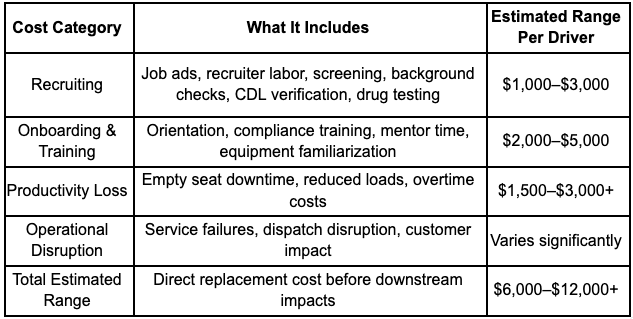
Retention improvements produce measurable operational ROI quickly. A 100-driver fleet operating at 80% annual turnover could spend approximately $480,000 to $960,000 annually on direct replacement costs alone. Reducing turnover by just 10 percentage points can therefore save fleets tens of thousands of dollars before accounting for improved customer stability, stronger safety performance, and reduced operational disruption.
What Causes Truck Drivers to Leave?
Truck drivers most commonly leave carriers for five reasons: inconsistent pay; poor home time predictability; unreliable equipment; lack of respect or communication from management; and better opportunities at competing fleets. ATRI research and industry driver surveys consistently identify these same operational and cultural issues as the primary causes of trucking turnover.
Pay Unpredictability
Drivers often tolerate difficult work conditions more easily than unpredictable compensation. Percentage-based or mileage-based pay structures can fluctuate heavily with freight demand, detention time, weather delays, and routing inefficiencies, making it difficult for drivers to predict their paycheck and make personal budgets, eroding trust in the carrier over time.
When drivers cannot reliably estimate weekly income, they begin comparing opportunities elsewhere — especially during stronger freight markets when recruiters actively target experienced CDL holders.
Home Time and Work-Life Balance
Home time predictability consistently ranks among the strongest driver retention factors in trucking. Regional and over-the-road drivers frequently cite missed family events, uncertain schedules, and repeated delays returning home as primary reasons for leaving a fleet.
Drivers who know when they will be home can plan their lives. Drivers who repeatedly miss promised home time often disengage long before they formally resign.
Equipment Reliability
Equipment quality directly shapes driver satisfaction because drivers spend most of their working lives inside the truck. Frequent breakdowns, unresolved maintenance issues, poor climate control, and outdated in-cab systems create frustration while also signaling that the carrier does not value driver time or safety.
Unreliable or poorly maintained equipment also creates operational stress by increasing roadside delays, missed appointments, uncertainty around load completion, and potential dangerous equipment malfunctions and breakdowns.
Management and Communication Problems
Effective retention-focused communication programs prioritize regular operational check-ins instead of limiting conversations to disciplinary reviews or annual evaluations. Broader workforce research supports this: Gallup found that 45% of employees who voluntarily left their jobs had no meaningful conversation with a manager in the three months before leaving. In trucking specifically, a Platform Science Driver Experience Survey of more than 1,100 commercial drivers found that retention hinges as much on trust and transparent communication as it does on pay rates.
Carriers can improve communication by proactively communicating with top performers and recognizing good driving habits as soon as they occur. Some fleets are also utilizing AI tools to respond more promptly to communication needs and support message scalability for managers.
Better Opportunities at Competing Carriers
High turnover across the trucking industry creates constant recruiting pressure. Experienced drivers know their market value and routinely receive competing offers promising better pay, newer equipment, more predictable routes, or stronger home time commitments.
When a fleet already struggles with communication, scheduling, or driver trust, outside offers become significantly more attractive.
Fleets trying to diagnose retention issues should conduct structured driver satisfaction surveys, stay interviews, and exit interviews regularly instead of relying on assumptions from dispatch or leadership teams. These conversations help carriers identify which turnover factors are most active inside their own operation before turnover accelerates further.
Fleet leaders looking for additional driver sentiment data can also review the Platform Science Driver Experience Survey for broader insight into what drivers consistently prioritize across commercial trucking operations.
How Do You Build a Driver Retention Strategy?
An effective driver retention strategy improves the operational and cultural conditions that cause drivers to leave in the first place. The strongest fleets address retention across eight connected areas: compensation transparency, predictable home time, equipment quality, onboarding and mentorship, communication and recognition, career progression visibility, driver-friendly technology, and continuous feedback loops.
No single retention initiative solves turnover by itself. Fleets that improve across multiple operational areas typically see compounding retention gains because drivers experience the entire work environment together, not one policy at a time.
How Does Pay Transparency Improve Driver Retention?
Pay unpredictability is one of the most common reasons truck drivers leave carriers. Drivers can often tolerate difficult routes or long hours more easily than compensation systems they cannot understand, verify, or predict consistently. Transparent pay structures build the trust driver retention depends on because drivers know how compensation is calculated before problems escalate into frustration.
Many fleets unintentionally create distrust through overly complicated pay statements filled with unclear deductions, inconsistent labels, detention adjustments, or changing bonus calculations. Drivers who cannot easily validate their compensation often assume they are being underpaid even when the actual rates remain competitive.
Fleets improve retention by simplifying pay statements, communicating policy changes proactively, and creating bonus programs with clearly defined qualification thresholds. Annual benchmarking against ATA compensation studies and Bureau of Labor Statistics wage data also helps fleets remain competitive as freight markets shift.
Heavy and tractor-trailer truck drivers earned median annual wages between roughly $54,000 and $58,000 entering 2025, depending on route type, experience level, and freight segment. Drivers compare compensation constantly across carriers, making transparency and predictability as important as headline pay rates themselves.
How Does Home Time Predictability Affect Driver Turnover?
Predictable home time reduces driver turnover more effectively than simply increasing total home days. Drivers who know when they will return home can plan family responsibilities, appointments, and personal commitments with confidence. Drivers who repeatedly miss promised schedules often disengage and begin searching for other carriers.
Additionally, many drivers accept demanding routes if dispatch consistently honors commitments and communicates schedule changes early.
Fleets improve home time retention by creating route options aligned to different driver preferences, allowing drivers to request preferred home days during scheduling, and tracking home time reliability internally as an operational KPI. Dispatch teams should also flag missed home time commitments proactively so operational leaders can address recurring problems before frustration compounds.
Technology also plays an important role in increasing home time reliability. Route optimization systems that account for Hours of Service constraints, traffic conditions, and realistic transit times reduce the operational tradeoff between delivery performance and driver home schedules.
How Does Equipment Quality Impact Driver Satisfaction?
Equipment quality directly affects driver retention because drivers spend more time inside their trucks than most employees spend in a traditional workplace. Reliable, well-maintained equipment improves safety, comfort, and operational consistency while signaling that the carrier respects the driver’s time and working conditions.
Reliability is a key dimension of driver satisfaction. Frequent breakdowns, unresolved maintenance problems, excessive downtime, and recurring roadside repairs create frustration while reducing driver earning potential through missed miles and delayed loads. Equipment malfunctions can also cause dangerous accidents or roadside breakdowns.
Modernity is also an important dimension in driver satisfaction. Drivers increasingly expect intuitive in-cab technology, reliable climate systems, modern navigation tools, and mobile workflows that reduce busywork throughout the workday.
Well-maintained trucks paired with driver-friendly, in-cab technology create a visible operational signal that the fleet prioritizes driver experience rather than treating drivers as interchangeable labor.
What Does an Effective Driver Onboarding Program Look Like?
According to recent studies, approximately 33% of new truck drivers leave within their first 90 days, and roughly 22% leave within six months, making onboarding the highest-risk stage of the driver lifecycle. Effective onboarding programs reduce early turnover by helping drivers understand company expectations, operational workflows, equipment, technology, and support systems before frustration compounds.
Strong onboarding programs extend beyond orientation day. Effective fleets structure onboarding as a formal acclimation process covering operational procedures, dispatch communication, safety expectations, technology systems, and cultural integration during the first 30 days, followed by scheduled check-ins at 30, 60, and 90 days.
Successful onboarding programs typically include four components:
- Mentor Pairing
New drivers receive a designated experienced driver or trainer who serves as a direct operational contact during the first 90 days.
- Technology Orientation
Drivers complete hands-on training for ELD systems, mobile apps, communication tools, and in-cab technology before first solo dispatch.
- Expectation Alignment
Fleet managers discuss compensation structure, route expectations, home-time policies, detention procedures, and operational realities clearly upfront.
- Structured 90-Day Check-Ins
Supervisors conduct formal satisfaction conversations before the highest-risk turnover window closes instead of waiting for problems to escalate.
How Do Communication and Recognition Programs Reduce Turnover?
A perceived lack of appreciation consistently ranks among the top reasons truck drivers leave carriers after compensation concerns. Gallup found that 45% of employees who voluntarily left their jobs had no meaningful conversation with a manager in the three months before leaving. In trucking specifically, a Platform Science Driver Experience Survey of more than 1,100 commercial drivers found that retention hinges as much on trust and transparent communication as it does on pay rates.
Effective retention-focused communication programs prioritize regular operational check-ins instead of limiting conversations to disciplinary reviews or annual evaluations. Fleets with stronger retention often conduct stay interviews with active drivers, asking what is working well and what operational frustrations need attention before resignation becomes likely.
Driver advisory councils also improve retention by giving experienced drivers a direct voice in routing policies, scheduling concerns, safety procedures, and technology rollout decisions.
Recognition programs reinforce positive engagement by acknowledging measurable driver contributions consistently. Safety milestone awards, tenure recognition programs, and gamified performance scorecards tied to meaningful incentives help drivers feel visible and valued. Gallup research shows that engaged employees have 59% lower voluntary turnover — a finding that applies directly to driver retention programs built around consistent recognition rather than compliance alone.
Fleets exploring direct driver sentiment can also review Platform Science LinkedIn driver poll insights to better understand the operational and communication issues drivers discuss most frequently.
Why Does Career Progression Visibility Matter for Driver Retention?
Drivers stay longer when they can see a future inside the organization. Many trucking fleets unintentionally signal stagnation by offering no visible path beyond the current driving role, causing experienced drivers to view the carrier as a temporary stop rather than a long-term career destination.
The absence of progression opportunities creates disengagement even among high-performing drivers. Carriers improve retention by creating clearly defined advancement paths such as trainer roles, mentor programs, dispatcher transitions, safety specialist positions, or specialized freight assignments tied to additional compensation and responsibility.
Some fleets also support tuition reimbursement or endorsement programs that help drivers earn hazmat, tanker, or advanced CDL qualifications while remaining employed.
Career progression conversations should not depend on drivers initiating the discussion themselves. Strong fleets integrate development planning into onboarding, 90-day reviews, annual evaluations, and ongoing retention conversations so drivers consistently understand what opportunities exist ahead of them.
How Does Technology Reduce Driver Turnover?
Fleet technology reduces driver turnover by eliminating the daily friction points that make a driver’s route more stressful and time-consuming than it needs to be. Mobile workflows, transparent pay systems, smarter routing, connected communication tools, and driver-friendly, in-cab platforms directly improve the driver experience. Technology that reduces frustration and busywork supports retention; technology that creates more friction accelerates turnover.
Pay Visibility and Settlement Transparency
Drivers lose trust quickly when they cannot understand how pay is calculated or when settlements arrive inconsistently. Automated settlement systems with transparent, itemized pay statements reduce the anxiety drivers experience when compensation feels unpredictable.
Modern payroll and settlement tools also reduce disputes over detention pay, mileage calculations, bonuses, and reimbursements because drivers can verify compensation clearly inside mobile apps or driver portals.
Administrative Burden Reduction
Paper logs, manual DVIR forms, disconnected workflows, and repetitive administrative tasks consistently rank among drivers’ most frustrating daily pain points. Modern ELD systems, digital inspections, electronic proof-of-delivery workflows, and low-tap mobile apps reduce the non-driving workload that cuts into productive time.
When drivers spend less time managing paperwork, they spend more time driving, resting, and meeting customer expectations.
Smarter Routing and Dispatch Support
Drivers experience significant operational stress when routes ignore Hours of Service constraints, road restrictions, fuel availability, parking limitations, or traffic conditions. HOS-aware route optimization tools reduce this burden by generating realistic routes that align with operational realities instead of relying on drivers to solve problems manually on the road.
Better routing also improves home-time predictability because dispatch plans routes more accurately around available drive time and delivery commitments.
Connected Communication Tools
Poor dispatch communication creates isolation and frustration, especially for over-the-road drivers operating independently for extended periods. In-cab messaging systems allow dispatchers and drivers to communicate safely without requiring drivers to rely on personal phones while driving.
Connected messaging tools also improve operational trust because drivers receive route updates, schedule changes, weather alerts, and customer information in one centralized workflow instead of through fragmented calls and texts. Modern communication management tools can silence certain notifications while wheels are turning or prioritize others to ensure drivers receive the most important information with as few distractions as possible.
Coaching and Recognition Systems
Driver scorecards and safety dashboards help improve retention when fleets use them for coaching and recognition instead of corrective measures alone. Real-time visibility into safety performance, fuel efficiency, and operational metrics gives drivers measurable goals and a clearer path toward incentive programs and recognition opportunities.
Positive coaching loops reinforce improvement and help drivers feel supported instead of constantly monitored.
What Trucking Technology Helps Improve Driver Retention?
Modern technologies for fleets can directly address pain points that motivate drivers to leave their current roles. Implementing these tools can drive down driver turnover and save fleets costs on recruitment, training, and operational disruption.
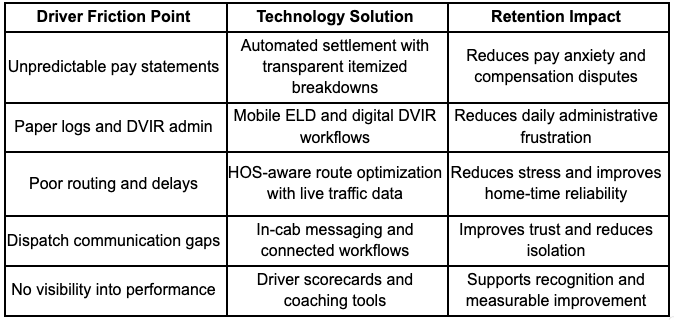
Platform Science Virtual Vehicle and PS Fleet Solutions are designed around many of these operational friction points. Virtual Vehicle unifies navigation, communication, ELD workflows, and driver applications into one OEM-native in-cab experience instead of forcing drivers to manage disconnected devices and apps across the workday.
Fleets exploring driver-focused technology workflows can also review Platform Science resources covering Virtual Vehicle, mobile device management and driver experience, in-cab workflow design, and the Road Pact marketplace integration available through the Platform Science ecosystem.
How Do You Measure Driver Retention Program Success?
Driver retention programs improve when fleets measure outcomes consistently over time. Strong retention measurement frameworks track five core KPIs: 30-day retention, 90-day retention, 180-day retention, annualized turnover rate, and average driver tenure. Fleets should pair these operational metrics with regular driver satisfaction surveys to connect retention outcomes to actual driver experience.
Early-retention KPIs matter because the first six months represent the highest-risk period in the driver lifecycle. Tracking retention at 30, 90, and 180 days helps fleets identify onboarding failures, communication problems, or operational friction before turnover patterns become entrenched.
Annualized turnover rate provides the primary benchmark against ATA industry averages, while average driver tenure reveals whether long-term workforce stability is improving for your fleet year over year.
Driver satisfaction scores add operational context to the numbers by helping fleets understand why drivers stay, disengage, or leave.
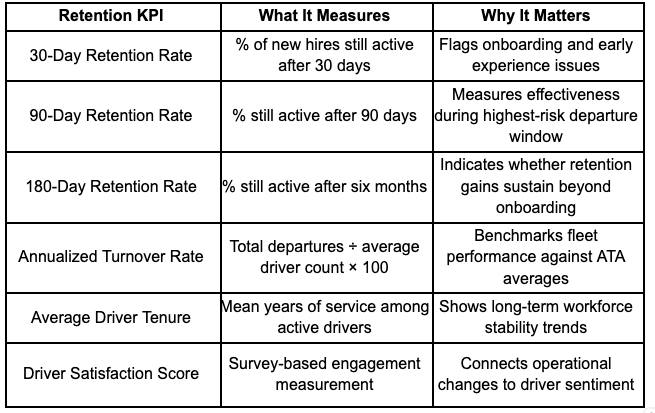
Effective retention measurement follows a continuous operational loop: establish baseline turnover metrics before launching new retention initiatives, implement operational improvements, collect driver feedback at structured intervals, compare outcomes against baseline performance, identify what improved and what failed to move, then refine the program accordingly.
Retention ROI should also be calculated directly. A simple framework is:
Turnover reduction × replacement cost per driver × fleet size = annualized retention savings
Using the industry replacement cost range of $6,000 to $12,000 per driver, a 10-point turnover reduction in a 100-driver fleet represents approximately $60,000 to $120,000 in annual direct savings before accounting for improved customer consistency, lower operational disruption, and stronger safety performance.
Fleets should review retention metrics regularly through monthly KPI dashboards, quarterly driver satisfaction analysis, and annual benchmarking against ATA and ATRI industry data.
Fleet leaders looking for additional benchmarking insight can also review the Platform Science Driver Experience Survey and related retention metrics research focused on operational drivers of turnover.
How Platform Science Supports Driver Retention
Platform Science builds fleet technology around the driver experience challenges described throughout this guide, specifically the operational friction points that contribute to turnover. Virtual Vehicle creates an OEM-native in-cab environment that unifies navigation, ELD workflows, communication tools, and connected apps into one driver-facing experience instead of forcing drivers to manage multiple disconnected devices.
Platform Science driver performance tools support real-time coaching and scorecard visibility that managers can use for recognition and improvement conversations rather than only disciplinary enforcement. The PS Virtual Vehicle Marketplace also gives fleets access to driver-focused apps such as Road Pact without requiring hardware replacement or disconnected workflows.
Fleets interested in broader driver experience trends can also explore the Platform Science Driver Experience Survey and additional research focused on what drivers consistently say improves day-to-day operations.
Frequently Asked Questions
What Are the Most Effective Strategies to Improve Driver Retention?
The most effective truck driver retention strategies are competitive and predictable pay structures, reliable home-time scheduling, high-quality equipment, structured onboarding with mentor support, and technology that reduces administrative friction during the workday.
How Much Does It Cost to Replace a Truck Driver?
Replacing a single truck driver typically costs between $6,000 and $12,000 in recruiting, screening, onboarding, and training expenses before accounting for productivity loss and operational disruption. At a 90% annual turnover rate, a 100-driver fleet could replace 90 drivers annually, representing roughly $540,000 to $1.08 million in direct replacement costs alone.
Why Is Home Time So Important for Truck Driver Retention?
Predictable home time reduces driver turnover because drivers can plan family responsibilities and personal commitments around reliable schedules. Driver surveys consistently identify unpredictable home time as one of the top reasons drivers leave carriers, even when competing offers provide only marginal pay increases.
How Does Fleet Technology Improve the Driver Experience?
Fleet technology improves driver experience by reducing operational friction throughout the workday. Mobile ELD apps replace paper logs, digital DVIRs improve inspection efficiency, automated settlement systems improve pay transparency, HOS-aware routing reduces navigation stress, and connected messaging tools improve communication between drivers and dispatch without requiring personal phones.
What Role Does Onboarding Play in Driver Retention?
Onboarding is the highest-leverage stage of the driver retention lifecycle because approximately 33% of new drivers leave within their first 90 days. Effective onboarding programs reduce early turnover through mentor pairing, hands-on technology training, expectation alignment around pay and home time, and structured 30-, 60-, and 90-day check-ins.


