


Fleet Management: The Complete Guide for Trucking
Fleet Management: The Complete Guide for Commercial Trucking Fleets
Key Takeaways:
- Fleet management unifies vehicle maintenance, driver safety, compliance, and cost control into one connected operational system.
- Modern trucking fleets run on six core pillars: HOS compliance, GPS dispatch/routing, digital inspections, preventive maintenance, fuel management, and driver performance monitoring.
- Driver-first fleet management, which prioritizes usability and transparency, improves safety outcomes and long-term driver retention.
- Implementing fleet management software follows a six-step process (needs assessment through KPI tracking), with most fleets seeing measurable ROI within two years.
Commercial trucking fleet management covers everything from vehicle maintenance and driver safety to compliance and fuel costs. Here's how modern fleets get it right.
Fleet managers balance driver retention, rising operating costs, compliance pressure, maintenance schedules, and delivery performance every day. Modern commercial trucking fleet management requires connected systems that give operations teams real-time visibility into vehicles, drivers, safety performance, fuel use, and regulatory compliance across the entire fleet.
This guide explains what fleet management is, how fleet management systems work, the six core operational pillars of modern trucking fleets, and how driver-first operations improve safety, retention, and efficiency. It also covers implementation strategies, benefits of fleet management software, operational KPIs, and emerging trends shaping connected fleet operations.
By the end of this guide, fleet managers will understand how to build a safer, more efficient, and more connected commercial trucking operation using modern fleet management technology and workflows.
Table of Contents
What Is Fleet Management?
Fleet management is the process of overseeing vehicles, drivers, compliance, maintenance, operations, and costs to improve efficiency, safety, and profitability in commercial trucking fleets (Forbes Advisor). Commercial fleet management combines operational workflows, connected technology, and performance tracking systems to keep vehicles compliant, drivers productive, and deliveries on schedule.
Modern trucking fleet management includes vehicle acquisition, preventive maintenance scheduling, driver oversight, fuel management, regulatory compliance, route planning, and operational reporting. Fleet managers use telematics platforms, ELD systems, maintenance software, and dispatch tools to monitor performance and reduce operational risk across the fleet.
Common fleet types include:
- Long-haul trucking fleets: Focus on Hours of Service compliance, fuel efficiency, and interstate route optimization.
- Local delivery fleets: Prioritize stop density, route efficiency, and rapid dispatch coordination.
- Commercial mixed fleets: Manage multiple vehicle classes, operational workflows, and maintenance requirements simultaneously.
- Specialty fleets: Support operations such as heavy haul, refrigerated transport, or hazardous materials hauling with unique compliance and equipment needs.
Fleet management scales across operations of every size, whether a company operates a single commercial vehicle or manages thousands of connected assets across multiple regions (Forbes Advisor).
How Fleet Management Works
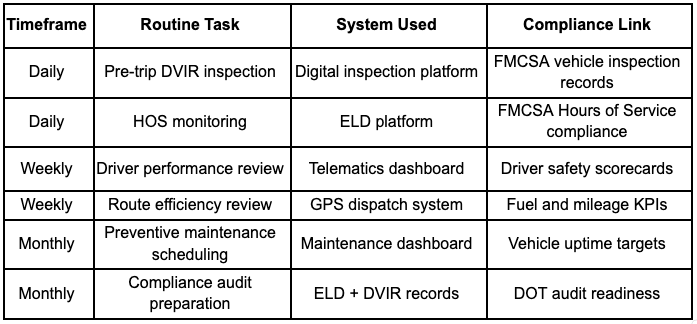
Fleet management works by combining driver oversight, vehicle monitoring, maintenance scheduling, compliance tracking, dispatch coordination, and operational reporting into a connected workflow.
Modern fleet management systems use telematics, ELD platforms, GPS tracking, and digital inspection tools to help fleet managers monitor vehicles and drivers in real time while reducing manual processes and compliance risk.
Telematics is a system that collects and transmits vehicle and driver data — including location, speed, braking behavior, fuel use, and engine diagnostics — to give fleet managers real-time visibility into every vehicle and driver in the fleet.
Integrated fleet management systems connect ELD and Hours of Service records, GPS dispatch tools, digital driver vehicle inspection reports (eDVIRs), maintenance dashboards, and driver scorecards into one operational environment. This integration reduces duplicate data entry, improves audit readiness, minimizes paperwork errors, and gives operations teams faster access to actionable fleet data.
What Are the Core Functions of Fleet Management?
Modern commercial trucking fleet management relies on six core operational systems: ELD and Hours of Service compliance, GPS dispatch and routing, digital inspections, preventive maintenance, fuel management, and driver performance monitoring. Together, these systems improve fleet safety, operational visibility, regulatory compliance, cost control, and long-term vehicle uptime.
ELD and Hours of Service systems help fleets maintain FMCSA compliance and reduce audit risk through automated electronic records. GPS dispatch and routing systems improve delivery efficiency, lower fuel consumption, and support real-time operational visibility across the fleet.
Digital inspections and preventive maintenance programs reduce the risk of breakdowns, extend vehicle lifespans, and improve DOT readiness. Fuel management systems help fleets monitor one of their largest operating expenses, while driver performance tools support coaching, retention, and fleet safety initiatives through real-time operational data.
Each pillar connects directly to uptime, driver accountability, cost reduction, and operational performance. The following sections break down how each system contributes to modern commercial fleet operations.
How Does Vehicle Maintenance Affect Fleet Uptime?
Vehicle maintenance improves fleet uptime by reducing unplanned breakdowns, extending vehicle life, and keeping trucks in safe operating condition. Preventive maintenance programs help commercial fleets identify mechanical issues early, reduce roadside breakdowns, and maintain consistent delivery schedules across the operation.
Preventive maintenance is a scheduled approach to servicing vehicles at planned mileage or engine-hour intervals to identify and correct issues before they cause equipment failures or safety problems.
Data-driven maintenance strategies produce measurable operational gains. Predictive maintenance technologies improve delivery reliability and reduce unplanned downtime, while fleets using digitized inspection workflows consistently report higher inspection completion rates and significant reductions in administrative costs.
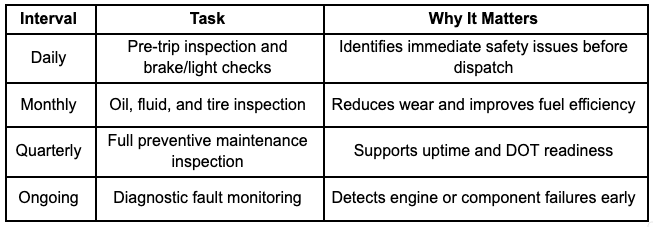
Modern maintenance systems also integrate with telematics platforms and digital inspections to trigger automated service alerts, maintenance scheduling, and repair tracking across the fleet.
How Do Fleets Manage Driver Performance and Safety?
Fleets manage driver performance and safety through structured onboarding, continuous training, telematics monitoring, real-time coaching, incident reporting, and performance scorecards. Driver-first fleet operations use connected technology to identify unsafe driving behaviors early, improve coaching consistency, reward positive driving habits, and support long-term driver retention and safety performance.
Telematics systems monitor behaviors such as hard braking, speeding, rapid acceleration, swerving, and excessive idling in real time. Fleet managers can use this live operational data to coach drivers immediately, rather than relying solely on after-the-fact incident reviews or annual evaluations. These negative driving habits are also associated with decreased fuel efficiency and increased likelihood of accidents, so addressing them earlier supports a safer and more efficient work environment.
AI-powered driver monitoring systems help fleets identify and reduce risky driving behaviors through continuous feedback and proactive coaching workflows, improving both safety performance and driver retention.
Best practices for building a driver-first fleet culture include:
- Provide consistent onboarding and recurring safety training.
- Use coaching data to support drivers instead of only enforcing penalties.
- Create transparent driver scorecards with measurable goals.
- Reduce administrative friction with digital workflows and mobile tools.
- Recognize and reward safe driving performance and operational consistency.
Driver management strategies also influence retention, recruiting, and operational stability. Fleets investing in driver experience and connected workflows often improve long-term workforce retention since drivers feel safer and spend less time on busywork and redundant data entry.
How Do Commercial Fleets Stay HOS Compliant?
Compliance is the set of processes and records fleets use to meet FMCSA regulations, including Hours of Service rules, ELD mandates, vehicle inspections, and driver safety standards. Strong compliance workflows reduce audit risk, lower exposure to violations, and help commercial trucking fleets maintain safe and legally compliant operations.
Hours of Service violations create significant operational and financial risk for carriers. FMCSA can fine motor carriers up to $19,246 per HOS violation and drivers up to $4,812 per violation, with penalty amounts adjusted annually for inflation (49 CFR Appendix B to Part 386).
Modern compliance workflows rely on three connected systems:
- FMCSA-certified ELD platforms: Automatically capture Hours of Service activity; generate and store audit-ready electronic records.
- Digital DVIR systems: Store pre- and post-trip inspection records electronically for faster reporting and DOT readiness.
- Compliance dashboards: Centralize driver records, inspection documents, alerts, and reporting tools for audit preparation and operational visibility.
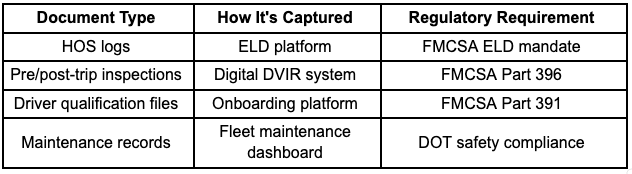
Connected compliance systems reduce paperwork errors, improve inspection readiness, and help fleets respond faster during DOT audits and roadside inspections.
How Can Fleets Reduce Fuel Costs?
Fuel management involves monitoring fuel usage, reducing waste, improving purchasing controls, and optimizing driver behavior to lower operating expenses. Fuel consistently ranks among the largest controllable operating expenses in commercial trucking, accounting for roughly 24% of per-mile operating costs according to the American Transportation Research Institute, and significantly more during periods of high diesel prices.
Modern fleet systems combine route optimization, telematics, and driver scorecards to reduce fuel burn and improve operational efficiency. GPS routing systems reduce unnecessary mileage, telematics platforms identify excessive idling and aggressive driving, and digital fuel tools help fleets detect unauthorized purchases or fuel fraud.
Fleet fuel reduction strategies include:
- Monitor fuel consumption by vehicle and route.
- Use dynamic route optimization to reduce mileage and idling
- Coach drivers on fuel-efficient driving behaviors.
- Implement digital fuel card controls and reporting tools.
Key fuel management KPIs include:
- Fuel cost per mile
- Cost per trip
- Idle time percentage
- MPG by vehicle
- Fuel variance by route
Fleets that combine operational visibility with driver coaching and route optimization typically achieve the strongest long-term fuel savings.
How Does Route Optimization Work for Commercial Trucks?
Route optimization uses algorithms and real-time operational data to assign the most efficient routes for commercial vehicles while accounting for delivery schedules, truck restrictions, weight limits, weather conditions, construction zones, high-congestion areas, and Hours of Service compliance. Modern routing systems help fleets improve delivery performance, reduce fuel costs, and minimize unnecessary mileage.
Advanced trucking route optimization platforms also automatically schedule mandatory driver breaks to help fleets maintain FMCSA Hours of Service compliance and reduce the risk of violations during long-haul operations.
Route optimization systems typically deliver measurable operational improvements through reduced fuel use, shorter delivery times, and lower mileage accumulation. Truck-specific routing features to prioritize include:
- Restricted road and bridge avoidance
- Real-time traffic and weather integration
- HOS break scheduling
- Hazmat and load restriction routing
- Vehicle height and weight compliance
- Dynamic rerouting during delays or closures
Route optimization improves both operational efficiency and driver experience by reducing unnecessary delays and simplifying dispatch coordination.
How Does Telematics Improve Fleet Operations?
Telematics is the use of connected technology to collect, send, and analyze real-time data from vehicles, drivers, and assets to improve operational visibility, safety, maintenance planning, and compliance management. Modern telematics systems help fleet managers monitor every vehicle and driver continuously through centralized dashboards and automated reporting tools.
When fleets integrate telematics platforms with mobile apps, ELD systems, dispatch software, maintenance dashboards, and operational reporting tools, they create faster operational feedback loops and more accurate decision-making workflows. Connected systems can automatically trigger preventive maintenance alerts, surface unsafe driving behaviors immediately, and generate audit-ready compliance records on demand.
The most valuable telematics data signals include:
- Vehicle location
- Speed and driving behavior
- Engine health and diagnostic codes
- Idle time
- Fuel consumption
- Harsh braking and acceleration events
- Route adherence
- Hours of Service activity
Real-time fleet visibility enables operations teams to respond more quickly to safety issues, equipment problems, delivery delays, and compliance risks across the fleet.
What Is Driver-First Fleet Management?
Driver-first fleet management is an operational approach that designs fleet technology, workflows, communication, and compliance systems around the driver's experience rather than focusing solely on back-office visibility. Driver-first fleets prioritize usability, transparency, safety, and operational support because fleets with better driver experiences typically achieve stronger retention, safer operations, and more consistent performance.
Driver turnover remains one of the largest operational challenges in commercial trucking. Annual turnover rates at large carriers regularly exceed 90%, and every preventable driver departure increases recruiting costs, onboarding expenses, lost productivity, and operational instability. Fleet technology that frustrates drivers often accelerates turnover, while systems that simplify workflows and reduce daily friction improve long-term retention.
Driver-first operations influence every area of fleet management. Intuitive mobile apps simplify DVIR completion, Hours of Service logging, and dispatch communication without forcing drivers through unnecessary steps. Real-time coaching systems work best when they help drivers improve their performance constructively rather than serving only as disciplinary tools.
Driver-first routing systems also account for Hours of Service requirements, realistic parking availability, and operational delays to reduce unnecessary stress during trips. Connected maintenance systems help prevent unexpected roadside breakdowns that disrupt schedules and frustrate drivers trying to complete deliveries safely and efficiently.
Trust also plays a critical role in fleet technology adoption. Drivers who understand why telematics data is being collected — and who see that the information supports safety, coaching, maintenance, and operational improvements — are more likely to engage productively with connected fleet systems.
Strong driver-first fleet cultures typically include:
- Drivers participating in technology evaluations and rollout decisions
- Fleet managers maintaining two-way feedback loops between drivers and operations teams
- Safety recognition programs rewarding positive performance rather than focusing solely on violations
- Mobile workflows reducing paperwork and simplifying communication on the road
How to Implement a Fleet Management System
Implementing a fleet management system requires fleets to assess operational needs, define required technologies, build compliance workflows, pilot deployments, train users thoroughly, and establish KPI-driven feedback loops. Successful fleet management implementations combine connected technology with operational processes that improve compliance, safety, driver experience, and long-term efficiency.
Most commercial trucking fleets follow a six-step implementation process:
- Assess operational and compliance needs across the fleet.
- Define the required fleet technology stack and integrations.
- Build automated compliance and inspection workflows.
- Pilot the platform with a representative group of vehicles and drivers.
- Train drivers, dispatchers, and managers to support adoption.
- Track operational KPIs continuously to improve workflows over time.
Modern fleet management systems should support open APIs, digital inspections, truck-legal routing, mobile workflows, and scalable integration capabilities from the beginning. Fleets that prioritize interoperability and driver usability typically achieve faster adoption and stronger long-term ROI.
How Do You Assess Fleet Management Needs Before Buying Software?
Fleet managers should assess operational requirements, compliance risks, routing complexity, maintenance maturity, and integration needs before evaluating any fleet management platform. A structured needs assessment helps fleets avoid buying disconnected tools that fail to support real operational workflows across drivers, vehicles, maintenance teams, and dispatch operations.
Before selecting a vendor, fleets should inventory vehicle types, route structures, maintenance processes, driver workflows, and existing software systems. Understanding current operational gaps helps fleets prioritize which technologies and integrations will create the most measurable operational impact.
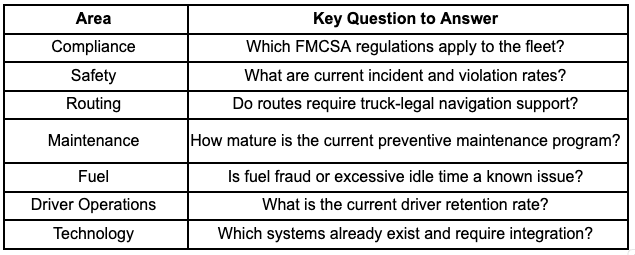
Strong assessment processes also identify operational bottlenecks early, making implementation planning more realistic and reducing disruption during deployment.
What Systems Does a Trucking Fleet Need?
A complete trucking fleet management stack typically includes ELD and Hours of Service software, truck-legal GPS routing and dispatch tools, digital DVIR systems, preventive maintenance platforms, fuel management controls, and mobile driver applications. These connected systems work together to improve compliance, safety, visibility, and operational efficiency across the fleet.
Core fleet management systems include:
- ELD and HOS platform: Automates FMCSA compliance and driver hours tracking.
- Truck-legal GPS and dispatch software: Supports compliant routing, dispatch coordination, and delivery visibility.
- Digital DVIR system: Captures pre- and post-trip inspections electronically.
- Maintenance management platform: Tracks preventive maintenance schedules, diagnostics, and repair workflows.
- Fuel and expense management tools: Monitor fuel consumption, purchasing controls, and operational costs.
- Driver mobile apps: Simplify communication, inspections, workflow updates, and task management on the road.
Before evaluating vendors, fleets should separate must-have requirements from optional capabilities.
How Do You Build Compliance Into Fleet Operations?
Fleets build compliance into daily operations by automating Hours of Service logging, digitizing inspection records, centralizing audit documentation, and embedding compliance checks directly into dispatch and maintenance workflows. Modern compliance systems reduce paperwork gaps, improve FMCSA audit readiness, and lower the operational risk associated with manual recordkeeping.
FMCSA-certified ELD systems, digital DVIR platforms, and centralized reporting dashboards are now operational requirements rather than optional compliance tools. Connected compliance workflows help fleets identify missing records, driver violations, inspection issues, and maintenance gaps before they become audit or enforcement problems.
A typical compliance evidence workflow follows this sequence:
Driver logs (ELD) → Vehicle inspections (digital DVIR) → Route and dispatch records (GPS systems) → Audit-ready reporting exports
When fleets centralize compliance records in a single connected system, they improve operational visibility and reduce the time required to respond to DOT inspections, insurance reviews, and FMCSA audits.
How Should Fleets Pilot New Fleet Management Software?
Fleets should pilot new fleet management software with a representative group of vehicles, drivers, dispatchers, and operational workflows before expanding deployment across the entire fleet. Pilot programs help fleets validate integrations, identify usability issues, confirm compliance workflows, and measure operational ROI before making larger technology commitments.
Representative pilots should include different vehicle types, route structures, and driver experience levels to surface operational challenges early. Testing systems under real operating conditions helps fleets evaluate driver adoption, dispatch coordination, maintenance workflows, and reporting accuracy before scaling implementation.
Phased rollouts also reduce operational disruption because fleet managers can adjust workflows, improve training materials, and resolve technical issues incrementally. This approach is especially important for large fleets with complex routing, compliance, and maintenance requirements.
How Do You Drive Fleet Technology Adoption?
Fleet technology adoption depends on consistent training, driver engagement, clear communication, and workflows that simplify daily operations instead of adding friction. Fleets that combine hands-on onboarding with ongoing coaching and mobile-friendly tools typically achieve stronger long-term adoption and operational ROI.
Best practices for fleet technology adoption include:
- Deliver short, focused training sessions instead of lengthy classroom instruction.
- Use hands-on demonstrations and real operational examples during onboarding.
- Provide accessible job aids and mobile support materials.
- Train supervisors to coach drivers continuously after rollout.
- Use mobile apps to support two-way communication between drivers and operations teams.
Fleet technology succeeds when drivers view the tools as operational support systems rather than surveillance systems.
How Do Fleet Managers Use Data to Improve Operations?
Fleet managers use operational data to identify inefficiencies, reduce downtime, improve safety performance, strengthen compliance workflows, and optimize overall fleet operations. KPI-driven fleet management creates a continuous improvement cycle where connected systems generate operational insights that teams can use to refine workflows and measure performance consistently.
Modern fleet dashboards typically track metrics such as inspection completion rates, vehicle downtime, fuel cost per mile, driver safety scores, Hours of Service violations, maintenance completion rates, and route efficiency trends. Sharing performance data transparently across operations teams and drivers also improves accountability and operational alignment.
Real-time reporting allows fleets to identify problems faster and adapt workflows continuously, rather than reacting only after operational failures. Fleets that consistently measure operational performance generally outperform those that rely on periodic reviews or disconnected reporting systems.
What Are the Benefits of Fleet Management Software?
Fleet management software helps fleets reduce risky driving behaviors, lower maintenance costs, improve compliance, and increase operational efficiency through connected workflows and real-time data visibility. Most fleets achieve measurable ROI well within the first two years through fuel savings, reduced downtime, fewer compliance penalties, and improved driver performance.
Integrated routing systems, telematics platforms, maintenance dashboards, and compliance tools help operations teams coordinate drivers, vehicles, inspections, and dispatch workflows from a centralized environment.
Key benefits of fleet management software include:
- Route optimization and eco-driving programs help fleets reduce fuel consumption and control operating expenses more effectively.
- Preventive maintenance scheduling and predictive analytics lower repair costs, reduce unplanned vehicle downtime, and extend the longevity of fleet assets.
- Connected compliance systems reduce FMCSA violations and improve audit readiness across the fleet.
- Driver coaching platforms improve safety performance and reduce high-risk driving behaviors.
- Real-time dispatch and routing systems improve on-time delivery performance and customer satisfaction.
- Most fleets achieve positive ROI from connected fleet technology deployments well within the first two years.
What Metrics Should Fleet Managers Track?
Fleet managers should track six core KPI categories: fleet utilization, preventive-to-reactive maintenance ratio, cost per mile, mean time between failures (MTBF), vehicle downtime percentage, and maintenance cost per mile. Together, these metrics show whether commercial trucking operations are running efficiently, safely, and within operational cost targets.
Compliance and inspection completion rates also function as leading indicators of regulatory risk. Fleets that monitor HOS violations, DVIR completion rates, and audit readiness consistently can identify operational gaps before they lead to FMCSA penalties, downtime, or failed inspections.
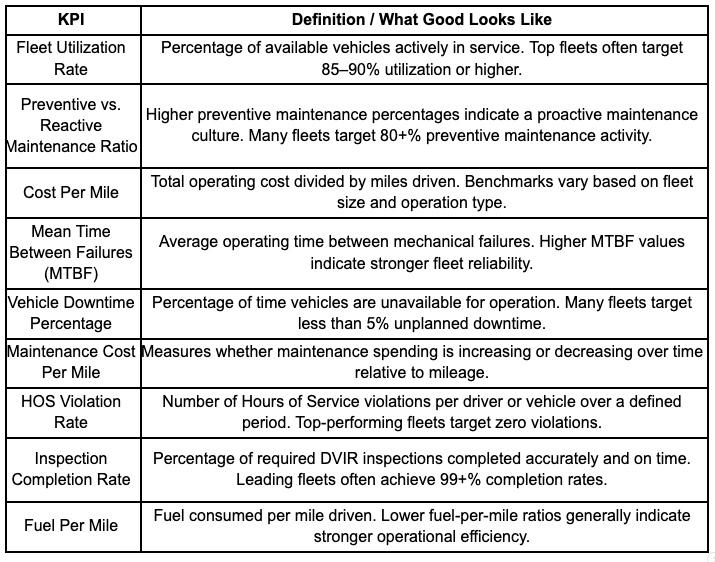
Tracking KPIs consistently helps fleet managers move from reactive problem-solving to proactive operational planning. Fleets that review operational data regularly typically improve uptime, reduce operating costs, and strengthen long-term compliance performance.
What Are the Emerging Trends in Fleet Management?
Fleet management is evolving rapidly through three major shifts: AI-powered operational intelligence, commercial vehicle electrification, and deeper OEM-native system integrations. The global fleet management market is projected to grow from $27 billion in 2025 to $122.3 billion by 2035, reflecting accelerating demand for connected, data-driven operations (Global Market Insights). Modern fleets increasingly rely on predictive analytics, connected vehicle ecosystems, and real-time operational visibility to improve safety, reduce downtime, and support more adaptive fleet operations.
AI and machine learning now play a larger role in telematics, safety monitoring, and maintenance planning. Real-time video intelligence systems can identify unsafe driving behaviors immediately, while predictive maintenance platforms analyze engine diagnostics and operational data to detect potential failures before they create costly breakdowns or delivery disruptions.
Electrification is also reshaping commercial trucking operations. EV fleet management introduces new operational considerations, including charging infrastructure planning, battery range management, route optimization for charging access, and evolving maintenance workflows for electric vehicles.
As fleets digitize more operational workflows, cybersecurity and data privacy become increasingly important. Connected fleet platforms collect sensitive driver, vehicle, compliance, and operational data continuously, making encryption, role-based access controls, and secure cloud infrastructure critical components of modern fleet management systems.
OEM-native integrations are also becoming a larger competitive advantage. Connected platforms that integrate directly with vehicle manufacturers can reduce hardware complexity, improve data quality, and create more unified operational experiences across vehicles, drivers, and fleet systems.
How Platform Science Approaches Connected Fleet Management
Platform Science is a connected fleet platform built around the driver-first operating model described throughout this guide. The Platform Science fleet management platform combines configurable workflows, open architecture, OEM-native integrations through Virtual Vehicle, and a unified mobile experience that supports drivers, dispatchers, compliance teams, and operations managers within one connected ecosystem.
Fleets exploring connected operations can learn more about Virtual Vehicle, Virtual Vehicle MDE, and how fleet management technology supports long-term driver retention through Platform Science resources.
Frequently Asked Questions
What is the fleet management process for commercial trucking?
The commercial trucking fleet management process includes vehicle and driver onboarding, preventive maintenance scheduling, compliance management, dispatch coordination, telematics monitoring, and operational reporting. Modern fleets use connected systems such as ELD platforms, GPS dispatch tools, digital DVIRs, and maintenance dashboards to maintain FMCSA compliance and improve operational efficiency.
What key performance metrics should fleet managers track?
Fleet managers should track cost per mile, preventive maintenance ratios, inspection completion rates, vehicle downtime percentages, and route efficiency metrics to evaluate operational performance. These KPIs help fleets monitor profitability, compliance readiness, maintenance effectiveness, and long-term operational reliability.
How often should commercial trucks be inspected and maintained?
Commercial trucks require daily pre- and post-trip inspections under FMCSA regulations, along with mileage-based preventive maintenance intervals and recurring quarterly inspections for deeper operational checks. Fleets that follow consistent preventive maintenance schedules generally reduce downtime and improve vehicle reliability.
How can fleet managers reduce downtime and operating costs?
Fleet managers reduce downtime and operating costs through preventive maintenance programs, real-time telematics monitoring, route optimization, and digital compliance workflows. These systems help fleets identify mechanical issues earlier, reduce fuel waste, improve operational efficiency, and lower the risk of costly FMCSA violations.
What are common challenges in managing trucking fleets?
Common trucking fleet management challenges include rising fuel and maintenance costs, driver retention and safety issues, FMCSA compliance requirements, unplanned vehicle downtime, and technology adoption across operations teams. Fleets that combine connected technology with driver-first operational workflows are generally better positioned to manage these challenges effectively.


