


What Is OEM-Native Telematics? Benefits & Limitations
What Is OEM-Native Telematics? How It Works, Benefits & Limitations
OEM-native telematics is hardware and software built into a vehicle at the factory, capturing location, engine, and diagnostic data and transmitting it to the cloud without any aftermarket device. It is a factory capability, not an add-on. When choosing a telematics architecture, fleets are deciding on installation cost, data depth, vehicle downtime, and long-term flexibility.
Table of Contents
- What Is OEM-Native Telematics?
- How Does OEM-Native Telematics Work?
- What Are the Benefits of OEM-Native Telematics?
- What Are the Limitations of OEM-Native Telematics?
- When Does Aftermarket Telematics Still Make Sense?
- How Should Fleets Choose Between OEM-Native, Aftermarket, and Hybrid?
- How Platform Science Approaches OEM-Native Telematics
- Frequently Asked Questions
What Is OEM-Native Telematics?
OEM-native telematics is a system in which the telematics control unit, modem, GPS, and supporting software are installed by the original equipment manufacturer (OEM) on the production line, rather than added to the vehicle after it is built.
Factory installation for telematics changes more than just where the hardware sits. The system is active from day one; it is wired into the vehicle's internal network rather than reading through a diagnostic port, and it is covered by the manufacturer's own engineering and warranty standards. Rather than a component bolted on after the fact, it is part of how the vehicle was designed to operate.
How Is OEM-Native Telematics Different From Aftermarket Telematics?
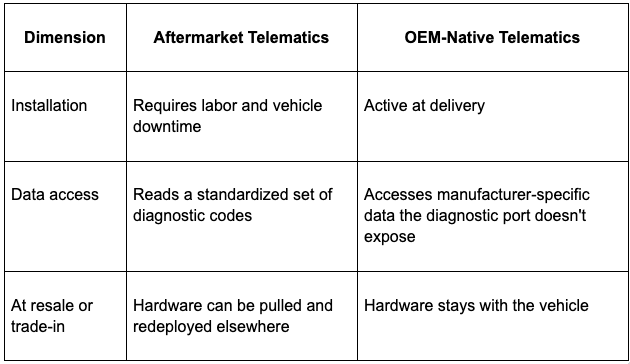
Aftermarket telematics connects through a standardized diagnostic port or hardwired install after the vehicle is built, while OEM-native telematics is embedded during production with direct access to the vehicle's internal network.
That distinction plays out in three practical ways:
What Does ‘Factory-Installed’ Actually Mean?
Factory-installed means the hardware is fitted on the assembly line and the software is provisioned before delivery, so the fleet activates service rather than installing equipment.
Buyers often lump three different OEM-related terms together, but they are not the same:
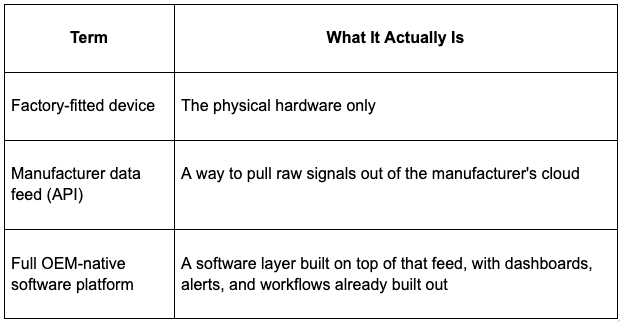
The distinction determines how much control and usable functionality a fleet gets on day one.
How Does OEM-Native Telematics Work?
OEM-native telematics uses factory-installed hardware and embedded software to gather vehicle data during operation, then transmit it directly to the cloud, where fleet software turns it into dashboards, alerts, and reports.
That process runs across three layers: the hardware physically in the vehicle, how data moves off the vehicle, and how fleets access it once it's in the cloud.
What Hardware Is Built Into the Vehicle?
Core components include a factory-installed cellular or satellite modem, GPS positioning hardware, a direct CAN bus connection, and sensors that monitor engine, brake, fuel, and tire systems.
The CAN bus connection is the technical heart of what separates OEM-native from aftermarket systems. The CAN bus is the vehicle's internal communication network; it's how the engine, transmission, brakes, and other systems communicate in real time. Its data link and physical layer are defined by ISO 11898-1, and heavy-duty vehicle communication over that network runs on SAE J1939, the industry standard governing how engines, transmissions, and other systems exchange data on the bus.
An aftermarket device typically reads through a diagnostic port, which exposes a standardized, limited subset of that traffic. A factory-installed system instead connects directly to the CAN bus, so it can see a much deeper, more manufacturer-specific stream of data — not just that something is wrong, but granular detail on exactly what is happening and where.
How Is Data Collected and Transmitted?
The onboard system gathers signals such as speed, idle time, and fault codes, packages them according to the manufacturer's specification, and sends them over cellular or satellite networks to the cloud. Transmission frequency and data formatting are set by the manufacturer, not the fleet.
This same direct engine connection is also what makes fleet compliance data reliable. Per FMCSA's ELD requirements, an electronic logging device (ELD) must synchronize with the vehicle engine to automatically record driving time for hours-of-service (HOS) purposes. A system with direct, factory-level access to the engine and CAN bus is well positioned to support that synchronization without relying on a separate diagnostic-port connection.
How Do Fleets Access OEM-Native Data?
Fleets access OEM-native data through APIs and secure connections into the manufacturer's cloud, surfaced in a fleet management dashboard, with service activated administratively rather than through hardware installation.
This is also what enables over-the-air updates. Because there's no physical device to swap or reflash, new features can be pushed to the fleet remotely with no shop visit, no technician, and no vehicle downtime. That's a meaningful differentiator compared to the operational model for aftermarket telematics, where adding capability often means replacing hardware.
What Are the Benefits of OEM-Native Telematics?
The three primary benefits of OEM-native telematics are:
- No installation cost or vehicle downtime
- Deeper diagnostic data
- Instant activation with over-the-air updates
No Installation Cost or Vehicle Downtime
OEM-native telematics eliminates three costs at once: the device purchase, the wiring labor, and the days a vehicle sits off the road during installation. The telematics hardware ships pre-installed in the truck and activates at delivery. For carriers regularly adding vehicles to their fleet, those savings compound across every unit brought into service, reducing the operational costs incurred when a truck sits in the shop bay instead of completing its route.
That downtime carries a real, quantifiable cost. According to ATRI's 2026 Analysis of the Operational Costs of Trucking, the industry-average cost to operate a truck in 2025 was $2.336 per mile, with non-fuel costs alone at $1.854 per mile. Every day a truck sits idle for aftermarket telematics installation is a day that cost structure is running without the truck generating revenue against it, which is a gap OEM-native architecture avoids by design.
Deeper Diagnostic Data From the Source
Factory integration provides access to manufacturer-specific fault codes, true odometer readings, precise fuel burn, oil life, and tire pressure data that standardized diagnostic ports do not expose.
This is the most technically differentiating benefit of OEM-native architecture. It's not that the data is generally "better." It's more specific — fault codes tied to the exact engine and drivetrain configuration, odometer readings unaffected by aftermarket calibration issues, and granular fuel and tire data that a diagnostic-port device simply can't see.
Instant Activation and Over-the-Air Updates
Fleets activate OEM-native service the day the vehicle arrives, with no install appointment and no waiting period. Because the hardware is already in the truck, new software features reach the fleet over the air. Adding capability means pushing an update, not scheduling a shop visit or swapping a device.
That changes how fleets plan capability rollouts. A new feature that would require touching every truck in an aftermarket deployment reaches the whole fleet at once, which removes the logistics work that normally gates a telematics upgrade.
What Are the Limitations of OEM-Native Telematics?
OEM-native telematics can create data silos across mixed-brand fleets, carry recurring subscription costs after initial trial periods expire, offer less configuration flexibility in closed manufacturer systems, and leave gaps for non-powered and older assets.
These limitations are real, and any fleet evaluating this architecture should weigh them seriously rather than treat OEM-native as a strictly preferable option in every case.
Data Silos Across Mixed-Brand Fleets
Fleets running trucks from multiple manufacturers may end up managing several separate OEM portals with different data formats, rather than one unified operational view.
In practice, that means duplicate logins, inconsistent reporting formats between manufacturers, and manual reconciliation work to get a single picture of fleet performance, which creates the operational friction that a fleet management platform is intended to eliminate.
Subscription and Renewal Costs
Many OEM telematics programs include a complimentary period that expires after a set term, after which fleets pay recurring per-asset subscription fees.
This isn't a hidden trap; it’s a total-cost-of-ownership consideration. The upfront savings on hardware and installation are real, but fleets should evaluate them alongside the long-run subscription cost.
Limited Flexibility in Closed Manufacturer Systems
Standard OEM reporting packages often offer less custom configuration than third-party platforms, and the manufacturer determines what a fleet can build, report on, or integrate.
This is the central tension in the OEM-native versus aftermarket decision: OEM-native systems are closed by default. What a fleet can customize, extend, or connect to other business systems depends on what the manufacturer chooses to expose.
Coverage Gaps for Non-Powered and Older Assets
OEM-native telematics covers only vehicles that left the factory with the hardware installed. Trailers, generators, towable equipment, and trucks built before factory telematics became standard have no system to activate. These assets require aftermarket tracking regardless of what architecture the rest of the fleet runs on.
For most fleets, that makes coverage a mixed question rather than a binary one. In practice, OEM-native rarely covers an entire operation on its own, which is why the hybrid approach discussed below becomes an option.
When Does Aftermarket Telematics Still Make Sense?
Aftermarket telematics remains the better fit for mixed-brand fleets that need one unified dashboard, fleets prioritizing advanced video and driver-facing safety systems, and non-powered assets with no factory system to activate.
For example, a fleet running five different truck brands may get more operational clarity from a single aftermarket platform than from stitching together five OEM portals. A fleet whose top priority is advanced driver-facing video and coaching may find purpose-built aftermarket safety systems more mature than what's bundled into a factory telematics package. And trailers, generators, and other non-powered equipment have no OEM system to plug into in the first place, so they require aftermarket solutions.
How Should Fleets Choose Between OEM-Native, Aftermarket, and Hybrid?
The decision comes down to fleet composition, asset age, primary operational goals, and whether the fleet needs a single unified view across mixed vehicle brands.
Four questions frame the decision, and the answer to each points toward one architecture or the other:
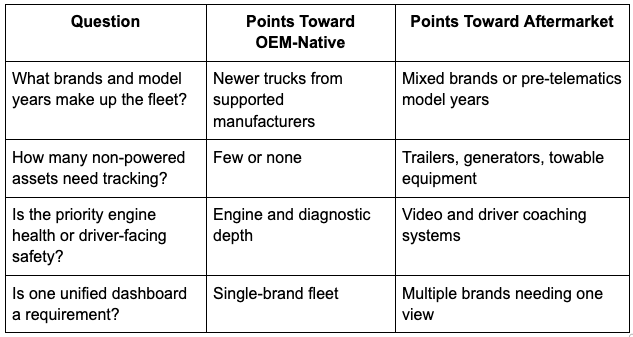
For many fleets, the answer isn't purely one or the other. The needed solution is a hybrid approach. That means using OEM-native as the data foundation on newer trucks — where it delivers the deepest diagnostic data at the lowest install cost — while extending aftermarket coverage to trailers, legacy vehicles, and specialized video systems that OEM-native can't reach.
How Platform Science Approaches OEM-Native Telematics
Platform Science builds on OEM-native architecture through Virtual Vehicle, which comes factory-installed from partner manufacturers, while keeping the platform open so fleets can add applications and integrations without changing hardware.
That combination directly addresses the limitations described above. Most OEM-native systems are closed by default, which creates the mixed-fleet silo problem and flexibility constraints. An open platform built on OEM-native foundations solves both: Fleets get the factory-level data depth without being boxed into a single manufacturer's reporting package or losing the ability to unify data across brands.
That openness shows up in the OEM partnerships behind Virtual Vehicle and in its extensive application add-on marketplace, which allows fleets to extend functionality and further customize operations without swapping hardware. [Learn more about Virtual Vehicle.]
Frequently Asked Questions
Is OEM Telematics Better Than Aftermarket?
Neither option is universally better. OEM-native is stronger for engine-level data, installation cost, and tamper resistance on newer trucks from supported manufacturers. Aftermarket is stronger for mixed-brand fleets, older vehicles, non-powered assets, and advanced video safety systems.
Which Truck Manufacturers Support OEM-Native Telematics?
OEM-native telematics support currently spans several major North American truck manufacturers, including Daimler Truck North America (Freightliner and Western Star), International Motors (formerly Navistar), and PACCAR's Kenworth and Peterbilt brands. Availability varies by model year, so fleets should confirm current support directly with the manufacturer for their specific truck configuration.
Can OEM-Native Telematics Work Across a Mixed-Brand Fleet?
It depends on whether the platform is open or closed. Closed manufacturer systems generally cannot unify across brands. Platforms built on OEM-native architecture with open integration can consolidate multiple sources into one operational view.
Does OEM-Native Telematics Require Hardware Installation?
No. The hardware ships with the vehicle from the factory, and service is activated through software rather than a shop visit.
What Happens to OEM Telematics When a Vehicle Is Sold?
The hardware stays with the vehicle because it's built in, unlike aftermarket devices that can be removed and redeployed. For the selling fleet, that means the telematics investment doesn't transfer to the next vehicle; for the buyer, it means factory data capability comes with the truck from day one.
Choosing the Right Telematics Architecture for Your Fleet
The OEM-native versus aftermarket decision affects installation cost, data depth, long-term flexibility, and how much of the fleet one system can cover. The wrong choice can mean paying for hardware that reads less, or locking into a system that cannot extend across the whole operation.
Platform Science offers a path that doesn't force that tradeoff: OEM-native data depth with open platform flexibility.
See how Virtual Vehicle delivers OEM-native telematics on an open platform →


