


What Is Fleet Telematics? A Guide for Fleets
What Is Fleet Telematics? A Complete Guide for Commercial Fleets
Key Takeaways:
- Fleet telematics integrates telecommunications and informatics to collect, transmit, and analyze vehicle and driver data in real time.
- A fleet telematics system combines on-vehicle hardware, GPS tracking, CAN bus diagnostics, cloud software, and wireless connectivity to create continuous operational visibility.
- Fleet telematics platforms collect data across location, speed, engine diagnostics, fuel consumption, driver behavior, Hours of Service (HOS) activity, and safety events.
- Route optimization and driver coaching powered by telematics can reduce fleet fuel consumption by approximately 10–25%, according to the U.S. Department of Energy. With fuel averaging $0.48 per mile in 2024 — the single largest controllable cost in trucking — even modest efficiency gains compound quickly across high-mileage fleets (ATRI, 2025).
- Automated telematics workflows help fleets manage ELD compliance, Hours of Service reporting, and IFTA recordkeeping without manual data entry.
- The global fleet telematics market is projected to grow from $10.42 billion in 2025 to $21.95 billion by 2032, at a CAGR of 11.2%, reflecting accelerating adoption across commercial transportation, logistics, and field service operations (MarketsandMarkets).
- Fleet managers evaluating telematics providers should prioritize scalability, integration flexibility, user experience, and cybersecurity protections.
Fleet telematics gives commercial fleets real-time visibility into every vehicle, driver, and asset. Here's how it works and what it delivers.
Fleet telematics is a connected vehicle technology that integrates telecommunications and informatics to collect, transmit, and analyze data from commercial vehicles. It captures real-time data like location, engine diagnostics, driver behavior, and fuel consumption to give fleet managers increased operational visibility across all fleet assets.
Fleet managers operating without this visibility are often making decisions with limited insight into driver behavior, vehicle health, routing efficiency, and compliance risk. Fleet telematics solves this issue by connecting vehicles, drivers, and operational systems into one continuous stream of live fleet intelligence.
This guide explains how telematics systems work, the hardware and software components involved, what data telematics platforms collect, the operational benefits they deliver, and what commercial fleets should evaluate when choosing a provider. It also covers how connected telematics systems support safety, maintenance, compliance, and driver performance across modern trucking operations.
For a broader overview of connected operations, see Fleet Management: The Complete Guide for Commercial Trucking Fleets.
Table of Contents
What Is Fleet Telematics?
Fleet telematics integrates telecommunications and informatics to collect, transmit, and analyze vehicle data including location, speed, engine diagnostics, and driver behavior to improve safety, efficiency, and compliance across commercial fleets. Telematics in trucking combines connected vehicle hardware and cloud software to give fleet managers real-time operational visibility across vehicles, drivers, and assets.
A fleet telematics system typically includes GPS tracking devices, telematics control units (TCUs), CAN bus or OBD-II diagnostic interfaces, wireless connectivity, and cloud-based fleet management software. Together, these components capture operational data from vehicles and transmit it to centralized platforms where fleet managers can monitor activity, generate reports, and automate workflows.
Commercial fleet technology powered by telematics supports operations across long-haul trucking fleets, local delivery vehicles, buses, heavy equipment, field service fleets, and specialty transportation operations. Any fleet that depends on operational visibility, compliance management, maintenance coordination, or driver oversight can use telematics systems to improve performance.
How Does Fleet Telematics Work?
Fleet telematics works by capturing operational data from vehicles and drivers through onboard hardware, transmitting that data through wireless networks, and processing it in cloud platforms that generate dashboards, alerts, reports, and operational insights for fleet managers. The system creates continuous real-time visibility into vehicle location, driver activity, maintenance status, and operational performance.
Modern fleet telematics systems operate across three connected layers:
- Vehicle hardware layer: Onboard devices collect vehicle, engine, location, and driver data.
- Wireless transmission layer: Cellular or satellite networks send data from the vehicle to cloud platforms.
- Cloud analytics layer: Fleet software processes the incoming data into reports, alerts, dashboards, and automated workflows.
A typical fleet telematics data flow follows this sequence:
- Vehicle hardware captures engine, GPS, sensor, and driver data.
- Wireless cellular or satellite networks transmit the information securely.
- Cloud platforms process and store the incoming telemetry.
- Fleet managers access actionable insights through dashboards, alerts, and integrated systems.
What Are the Core Components of a Fleet Telematics System?
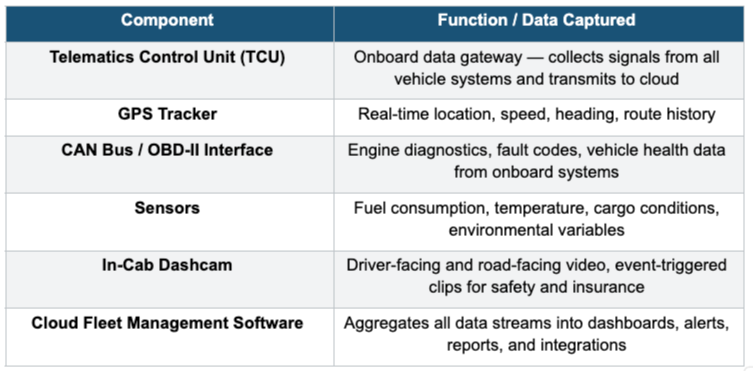
A fleet telematics system includes six primary components: the telematics control unit (TCU), GPS tracker, CAN bus or OBD-II diagnostics interface, environmental sensors, in-cab dashcam, and cloud-based fleet management software. Each component captures a different operational data stream that the telematics platform combines into one connected operational view.
- The telematics control unit acts as the onboard data gateway, collecting signals from vehicle systems and transmitting them to cloud platforms through wireless networks.
- The GPS tracker reports real-time vehicle location, speed, route history, and directional movement to the fleet telematics platform.
- The CAN bus and OBD-II interface read engine diagnostics, fault codes, fuel data, and vehicle health information directly from onboard truck systems.
- Environmental and operational sensors capture data such as fuel consumption, cargo temperature, trailer conditions, and other variables tied to the vehicle or load.
- In-cab dashcam systems record road-facing and driver-facing video footage, generating event-triggered clips for safety coaching, incident investigation, and insurance documentation.
- Cloud-based fleet management software aggregates all telematics data streams into dashboards, reports, alerts, workflows, and operational integrations accessible from connected devices.
All telematics system components connect wirelessly and continuously exchange data across the fleet ecosystem. Tight integration between hardware, connectivity, and software layers is critical because disconnected systems create reporting gaps, operational blind spots, and inconsistent workflows.
How Is Telematics Data Collected and Transmitted?
Vehicle-mounted telematics devices continuously capture operational data — including location, speed, engine activity, driver inputs, and diagnostic information — and transmit it through cellular or satellite networks to cloud platforms that generate real-time dashboards and alerts. Most commercial fleet telematics systems transmit location and operational status continuously, with update frequencies ranging from seconds to minutes depending on the platform and connectivity environment.
A typical telematics data transmission process follows four steps:
- Sensors, GPS devices, and the telematics control unit capture vehicle and driver activity continuously.
- The telematics system packages the data and transmits it through cellular networks or satellite connections.
- Cloud platforms receive, process, store, and organize the incoming operational data.
- Fleet dashboards, reports, and automated alerts surface actionable operational insights to fleet managers.
Cellular networks handle most fleet telematics communication because they provide broad coverage and fast data transfer across major transportation corridors. Satellite connectivity (also known as edge computing) becomes important for fleets operating in remote areas, rural regions, mining operations, or long-haul routes where cellular coverage is inconsistent or unavailable.
What Does Fleet Telematics Software Do?
Fleet telematics software is the cloud platform that aggregates data from vehicles, drivers, sensors, and connected systems and converts that information into dashboards, alerts, and reports that fleet managers use to support maintenance, compliance, safety, and dispatch decisions. The software layer transforms raw telemetry into actionable operational intelligence for fleet managers.
Modern telematics software platforms generate four major categories of operational output:
- Predictive maintenance insights: Diagnostic data and fault codes trigger maintenance alerts before breakdowns occur.
- Compliance workflows: Integrated reporting supports ELD, Hours of Service, DVIR, and IFTA compliance requirements automatically.
- Driver coaching and safety analysis: Driver behavior data and video events help fleets identify speeding, harsh braking, fatigue, and other risky driving patterns.
- Real-time visibility and routing: GPS-based location tracking gives dispatchers live vehicle positioning, supports route optimization, and improves ETA accuracy for customers and drivers alike.
The software platform also acts as a single source of truth across fleet operations. Instead of managing disconnected maintenance tools, compliance software, and reporting spreadsheets separately, fleet managers can centralize operational workflows within one connected telematics environment.
Fleets evaluating connected operations can explore Platform Science telematics capabilities and Instinct Workflow tools to see how integrated telematics platforms support operational visibility and workflow automation across commercial trucking fleets.
What Data Does Fleet Telematics Collect?
Fleet telematics platforms collect data across several core categories including GPS location, vehicle speed and heading, engine diagnostics and fault codes, fuel consumption, odometer and mileage, driver behavior metrics, and compliance records. Together these data streams give fleet managers continuous visibility into vehicle health, driver performance, routing efficiency, and regulatory compliance status (U.S. Department of Energy).
- GPS location data provides real-time vehicle tracking, geofencing alerts, route history, and estimated arrival times across the fleet.
- Vehicle speed and heading data identifies speeding events, route deviations, unsafe driving patterns, and operational inefficiencies tied to routing behavior.
- Engine diagnostics and fault codes monitor vehicle health continuously by reading onboard systems through the CAN bus or OBD-II interface. Fleets use this data to trigger predictive maintenance alerts and prioritize repairs before breakdowns occur.
- Fuel consumption data tracks fuel burn, idle time, and efficiency trends that fleets use to reduce operating costs and coach eco-driving behaviors.
- Odometer and mileage data supports IFTA reporting, preventive maintenance scheduling, route verification, and overall asset utilization tracking.
- Driver behavior metrics measure harsh braking, rapid acceleration, speeding, cornering, and idling patterns to support driver coaching and safety benchmarking.
- Video event data from in-cab dashcams captures road-facing and driver-facing footage during triggered safety events, supporting incident review, insurance claims, and exoneration evidence.
- Environmental sensors monitor temperature, humidity, cargo conditions, and refrigeration performance for fleets transporting temperature-sensitive or regulated freight.
- Compliance records integrate telematics data with ELD, Hours of Service, DVIR, and IFTA workflows to automate regulatory reporting and improve audit readiness.
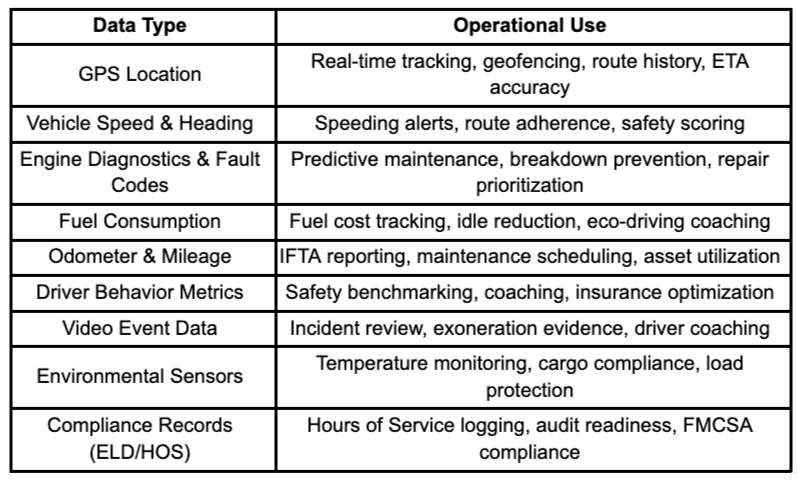
Integrated telematics platforms use these connected data streams to automate compliance workflows, improve maintenance planning, and create operational visibility across dispatch, safety, and fleet management teams.
What Are the Benefits of Fleet Telematics?
Fleet telematics delivers measurable operational improvements across fuel efficiency, maintenance planning, driver safety, regulatory compliance, and decision-making speed. Fleets using route optimization and driver coaching tools can reduce fuel costs, while predictive maintenance alerts help reduce unplanned downtime and improve long-term vehicle reliability.
- Since fuel costs represent more than 20% of a fleet’s operating budget, fuel savings represent one of the fastest telematics ROI drivers for commercial fleets. GPS routing, idle reduction alerts, eco-driving scorecards, and route optimization tools help fleets lower unnecessary fuel burn while improving dispatch efficiency and route planning accuracy.
- Predictive maintenance workflows reduce repair costs and prevent breakdowns by identifying engine faults and maintenance issues before vehicles fail on the road. Telematics platforms continuously monitor diagnostics data and trigger maintenance alerts automatically based on fault codes, mileage thresholds, and operating conditions (U.S. Department of Energy). Fleet management tools can automate maintenance schedules, optimizing time for both trucks and maintenance teams.
- Driver safety programs powered by telematics reduce harsh braking, speeding, and distracted driving events through scorecards, dashcam footage, and real-time coaching tools. Fleets with stronger driver safety performance typically see lower accident rates, improved CSA scores, and reduced accident-related operational costs – including insurance rates –over time.
- Automated compliance workflows simplify ELD, Hours of Service, DVIR, and IFTA reporting by eliminating manual paperwork and centralizing audit-ready records within one connected platform. This improves data quality and compliance, and reduces busywork for drivers and back office staff.
- Real-time data dashboards also improve operational decision-making speed. Dispatchers and fleet managers can reroute vehicles, identify delays, monitor driver activity, and respond to maintenance issues immediately instead of relying on delayed reporting or disconnected systems.
The global fleet telematics market is projected to grow from $10.42 billion in 2025 to $21.95 billion by 2032, at a CAGR of 11.2%, reflecting accelerating adoption across commercial transportation, logistics, and field service operations (MarketsandMarkets).
Fleet telematics use cases now span long-haul trucking fleets, last-mile delivery operations, heavy-haul transportation, refrigerated logistics, utility fleets, and public transit systems where operational visibility and compliance are critical.
What Should You Look for in Fleet Telematics Software?
When evaluating fleet telematics software, commercial fleets should focus on four core criteria: scalability across vehicle types and geographic regions, integration depth with existing operational systems, usability for both managers and drivers, and data security protections. The strongest telematics platforms connect operational data across the entire fleet while remaining flexible enough to support long-term operational growth.
Scalability determines whether the platform can support multiple asset classes, locations, and operational workflows without creating system fragmentation. Integration capabilities establish how well telematics data flows into dispatch, maintenance, payroll, compliance, and reporting systems already used across the fleet.
User experience also plays a major role in adoption success. Fleet managers need operational dashboards and configurable alerts, while drivers need mobile workflows that simplify inspections, navigation, Hours of Service logging, and communication on the road.
Finally, connected fleet systems collect sensitive operational and driver data continuously, making cybersecurity, data privacy, encryption, and secure access controls critical requirements for any enterprise telematics deployment.
The following sections explain how fleets should evaluate each area in detail.
Does the Platform Scale Across Vehicle Types and Locations?
A scalable fleet telematics platform supports multiple asset types including light-duty vehicles, heavy-duty trucks, trailers, and non-powered assets, while operating consistently across multiple terminals, regions, and international operations.
Large telematics providers now support global fleet operations across hundreds of thousands of connected vehicles. Fleet managers evaluating scalability should ask vendors specific questions about:
- Multi-asset support across powered and non-powered equipment
- Multi-location operational dashboards
- International regulatory compliance capabilities
- Language localization and regional configuration options
- Cloud infrastructure performance at enterprise scale
Scalable telematics systems help fleets standardize operations while supporting future growth, acquisitions, and geographic expansion.
How Well Does It Integrate With Existing Fleet Systems?
Fleet telematics software should integrate directly with transportation management systems (TMS), ERP platforms, maintenance software, route optimization tools, payroll systems, and compliance workflows through APIs, cloud connectors, or certified integrations. Strong integration eliminates manual data re-entry and creates faster operational workflows across dispatch, maintenance, compliance, and accounting teams.
Poor system integration creates operational silos, duplicate administrative work, delayed reporting, and compliance gaps when records fail to synchronize between systems. Disconnected workflows also slow decision-making because fleet managers must pull data from multiple platforms manually.
Strong telematics integrations support workflows such as:
- Payroll systems automatically syncing mileage and driver activity
- Maintenance scheduling triggered by engine diagnostics and fault codes
- Dispatch platforms receiving real-time driver and route status updates
- Compliance systems centralizing ELD, DVIR, and HOS reporting automatically
Fleets evaluating connected operations can also explore Platform Science’s Virtual Vehicle Marketplace integrations to understand how open app ecosystems extend telematics functionality and support customization across commercial trucking operations.
Is the Interface Usable for Both Managers and Drivers?
Fleet telematics platforms must support two different user groups simultaneously: fleet managers who need dashboards, alerts, reports, and operational analytics; and drivers who need mobile tools that simplify navigation, DVIR completion, Hours of Service workflows, and communication. A platform that works for operations teams but frustrates drivers will struggle with long-term adoption.
Strong manager interfaces typically include:
- Real-time fleet tracking maps
- Customizable operational alerts
- Exportable compliance reports
- Benchmarking dashboards and KPI reporting
- Centralized workflow visibility across vehicles and drivers
Strong driver-facing experiences typically include:
- Simple mobile interfaces with minimal taps
- Integrated navigation and dispatch workflows
- In-app coaching and communication tools
- Offline functionality for low-connectivity areas
- Fast access to inspections, HOS logs, and workflow tasks
Driver usability directly affects compliance accuracy, technology adoption, and operational consistency. Fleets evaluating connected workflows can explore Platform Science Navigation and Instinct Workflow tools as examples of integrated driver-facing operational systems.
How Does the Platform Handle Data Security and Privacy?
Fleet telematics platforms collect sensitive operational data including vehicle locations, driver behavior records, engine diagnostics, compliance logs, and route history, and must protect that information through encryption, secure authentication, role-based access controls, and continuous firmware and software updates (U.S. Department of Energy). Connected fleet cybersecurity is now a core operational requirement rather than a secondary IT consideration.
Commercial fleets operating internationally or within regulated industries may also need to comply with regional privacy standards such as GDPR in Europe or CCPA in California. Telematics vendors supporting enterprise fleets should provide clear documentation around data handling, retention, and privacy controls.
Before selecting a telematics platform, fleets should ask vendors about:
- Encryption standards for data in transit and at rest
- Role-based access permissions
- Data retention and deletion policies
- Breach notification procedures
- Third-party security audits and certifications
- Frequency of firmware and software patch updates
Strong security practices reduce operational risk while protecting sensitive driver, vehicle, and compliance data across connected fleet environments.
How Do You Implement Fleet Telematics?
Implementing fleet telematics successfully requires fleets to follow a structured five-step process: define operational goals and KPIs, pilot hardware with a representative fleet segment, integrate telematics with existing systems, train drivers and managers thoroughly, and continuously measure and optimize performance over time. Strong telematics deployments combine connected technology with disciplined operational change management.
Most commercial fleet telematics rollouts follow these five stages:
- Define measurable operational objectives and reporting requirements.
- Pilot telematics hardware and workflows on a representative subset of vehicles.
- Integrate telematics data into dispatch, maintenance, compliance, and reporting systems.
- Train drivers, dispatchers, and managers to support adoption and operational consistency.
- Measure operational KPIs continuously and optimize workflows over time.
Technology adoption depends as much on people and operational processes as it does on hardware and software. Fleets that invest in communication, training, and workflow alignment typically achieve faster adoption and stronger long-term ROI from telematics systems.
How Do You Define Objectives Before Deploying Telematics?
Fleets should define measurable operational objectives before evaluating telematics hardware or software because clear goals determine which data, reports, integrations, and workflows matter most. Common telematics deployment goals include reducing fuel costs, lowering downtime, improving driver safety scores, decreasing Hours of Service violations, and increasing operational visibility across dispatch and maintenance operations.
Each operational objective should map directly to a measurable KPI and supporting system capability. For example, fuel reduction goals require telematics reports tracking idle time, route efficiency, and fuel consumption trends, while maintenance reduction goals require diagnostic integrations and predictive maintenance alerts.
Successful telematics planning also requires cross-functional input. Operations teams define performance targets, IT teams assess integration and security requirements, and drivers identify workflow concerns that could affect adoption during deployment.
How Should You Run a Telematics Pilot?
Fleets should run telematics pilots using a representative mix of vehicles, routes, and drivers instead of selecting only the easiest or most cooperative operational group. Representative pilots surface real-world deployment challenges early and help fleets validate hardware performance, workflow compatibility, and operational ROI before expanding telematics across the entire fleet.
Pilot programs should include different vehicle classes, operating conditions, and driver experience levels to test how the telematics system performs across actual fleet operations.
Hardware selection also matters during the pilot phase. OBD plug-in devices support faster deployment for light-duty vehicles, while hardwired telematics control units are typically better suited for heavy-duty trucks and complex commercial fleet environments. Fleets evaluating video telematics should also test in-cab dashcam systems during the pilot stage.
Strong pilots also include structured feedback loops. Fleet managers should collect input from drivers, dispatchers, maintenance teams, and operations managers to identify usability issues, workflow friction points, and missing capabilities before scaling deployment.
How Do You Integrate Telematics With Existing Business Systems?
Fleet telematics systems integrate with maintenance platforms, dispatch systems, compliance tools, payroll software, and operational reporting environments to create connected workflows across the fleet. Strong integrations reduce manual data entry, eliminate operational silos, and improve decision-making speed across maintenance, dispatch, compliance, and accounting teams.
Common telematics integration workflows include:
- Engine diagnostic fault codes automatically triggering maintenance work orders
- Real-time vehicle and driver status syncing with dispatch and route optimization systems
- ELD and mileage data feeding directly into IFTA and compliance reporting workflows
API-first integration strategies help fleets automate data exchange between systems while maintaining centralized operational visibility. Before deployment, fleets should configure user roles, access permissions, automated notifications, and reporting workflows to ensure telematics data flows correctly across connected systems.
Integration complexity is often underestimated during telematics deployments. Fleets should allocate time for testing APIs, validating data synchronization, and troubleshooting workflow dependencies before rolling telematics systems out fleetwide.
How Do You Drive Telematics Adoption Among Drivers?
Fleet managers improve telematics adoption by positioning connected technology as a driver support tool rather than a punitive surveillance system. Drivers are more likely to embrace telematics when they understand that the platform protects them from false claims, reduces paperwork, supports safer driving, and simplifies daily workflows such as inspections, navigation, and Hours of Service reporting.
Strong telematics training programs typically include:
- Short, focused training sessions instead of long classroom instruction
- Hands-on hardware and mobile app demonstrations
- Accessible digital job aids and workflow guides
- Designated “power users” who support peers during rollout
- Ongoing coaching after deployment instead of one-time onboarding
Driver coaching programs also perform better when fleets use telematics data to recognize improvement and support safer driving habits rather than focusing only on violations or disciplinary action. Positive reinforcement improves adoption, trust, and long-term operational consistency.
How Do You Measure Telematics ROI Over Time?
Fleets measure telematics ROI by tracking operational performance against the KPIs established before deployment, including fuel cost per mile, downtime rates, safety incident frequency, Hours of Service violations, and inspection completion percentages. Continuous KPI tracking helps fleet managers determine whether telematics systems are delivering measurable operational and financial improvements.
Strong telematics review programs typically include:
- Monthly KPI dashboard reviews
- Quarterly vendor and system performance evaluations
- Annual hardware assessments and cybersecurity audits
- Ongoing operational workflow reviews
Telematics systems should also evolve over time as fleets learn from operational data. Fleet managers often refine alert thresholds, reporting formats, integrations, driver scorecards, and maintenance workflows continuously to improve operational efficiency and reduce unnecessary noise within the platform.
How Platform Science Approaches Fleet Telematics
Platform Science is a connected fleet platform built on the open, integrated architecture described throughout this guide. Platform Science fleet telematics combines OEM-native connectivity through Virtual Vehicle with an open app ecosystem in the Virtual Vehicle Marketplace, allowing fleets to configure workflows, add applications, and modernize in-cab experiences without replacing hardware.
Fleets exploring connected telematics operations can also learn more about Virtual Vehicle, the Virtual Vehicle in-cab experience, and vehicle and asset tracking capabilities through Platform Science resources.
Frequently Asked Questions
What Is the Difference Between Fleet Telematics and GPS Tracking?
GPS tracking is one component of fleet telematics because it only provides vehicle location and movement data. Fleet telematics combines GPS tracking with engine diagnostics, driver behavior monitoring, fuel consumption analysis, video event capture, and compliance workflows to give fleet managers a complete operational view instead of only a location map.
How Difficult Is It to Install Fleet Telematics Devices?
Fleet telematics installation complexity depends on the hardware type and vehicle environment. OBD plug-in devices can often be installed within minutes in light-duty vehicles, while hardwired telematics control units for heavy-duty trucks typically require professional installation and integration support from certified technicians. Learn how C.R. England successfully implemented Platform Science solutions into their entire fleet of 4,000 trucks in just five months
Do Small Fleets Need Fleet Telematics?
Yes. Small fleets benefit from telematics through automated ELD and Hours of Service compliance, fuel tracking, driver safety monitoring, and operational visibility that would otherwise require manual processes. Compliance automation alone often creates measurable operational value for fleets subject to FMCSA regulations.
How Does Fleet Telematics Support Regulatory Compliance?
Fleet telematics automates key compliance workflows by electronically recording Hours of Service activity through ELD systems, tracking IFTA mileage by jurisdiction automatically, and digitizing pre-trip and post-trip inspection records. Connected telematics platforms also centralize compliance documentation into exportable records that fleets can use during DOT audits and roadside inspections.


