


Industry Perspectives: Driving Efficiency with Marketplace Innovation
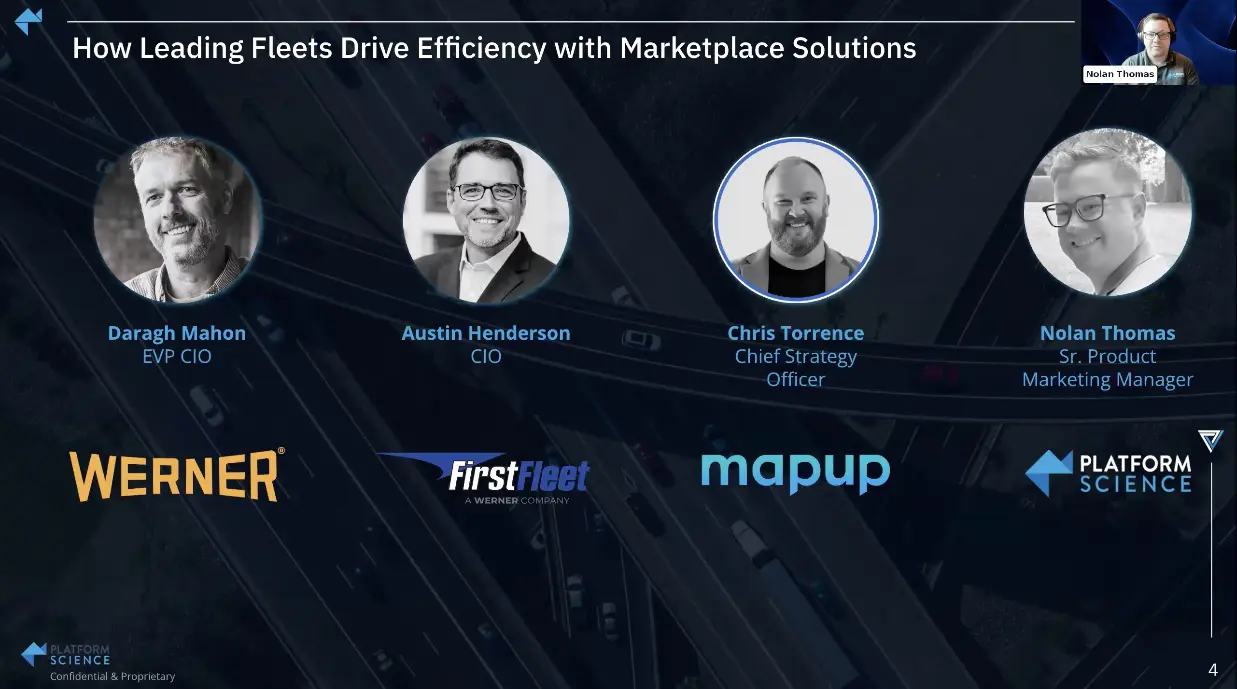
Summary: Platform Science recently hosted a webinar with Daragh Mahon (Executive Vice President and CIO of Werner Trucking Co.), Austin Henderson (CIO of FirstFleet, a Werner company), and Chris Torrance (Chief Strategy Officer at MapUp). The conversation covered the recent acquisition of FirstFleet by Werner, their collaboration with MapUp, and other topics such as:
- the most significant hidden costs for fleets
- how automation is transforming fleet operations
- the benefits of AI in the trucking industry
- the importance of driver feedback
- the connection between technology developers and fleets
Below are a few of the key takeaways from the discussions, but you can also watch the full webinar here.
What are some of the most significant hidden costs that fleets might be missing?
1. Tolling
Tolling expenses are sometimes ignored by fleets, since they often don’t have a strong checks-and-balances system as they do with other spend models. The ability to audit those transactions, rather than relying solely on billing agencies, increases your visibility into the costs associated with moving your assets. For example, sometimes the fleet is being charged for assets that could be decommissioned to save costs. Also, be sure to review and understand how the cost is associated with the transponder's location. Finally, ensure tolling devices are being used appropriately.
There are also opportunities to adjust potential revenue streams associated with tolling on freight bills. Sometimes tolls are billed to customers, but there can be delays in the toll flow into the inbound system for freight bills that generate revenue. Fleets need systems that more accurately estimate toll exposures based on actual GPS travel lines.
2. Network Compliance for Fueling
Ask yourself if your fleet is considering what your authorized network of fuel purchases are versus the optimal way to buy that fuel in the travel line that the driver is on today (based on telemetry in the truck, in real time). Execute the most optimal transactions within your network and make better decisions to harvest additional savings. When looking at larger fleets, even a savings of 1% or a tenth of a mile over all the fuel they purchase in a year can add up to massive savings across an entire fleet.
3. Costs Associated with Tech, Especially Cybersecurity
Most trucks today are like rolling computers, and you must have a good solution to monitor data ports, especially to watch for unauthorized activity on or off the truck. Just as safety systems like anti-collision, emergency braking, and adaptive cruise control weren’t traditionally part of every truck but are now deployed across every fleet, cybersecurity is increasingly imperative to include and optimize in your fleets. Fleets must ensure that the hidden costs of tech and security are recognized, tracked, and factored into overall fleet costs.
What manual workflows in your fleets have been the most transformed by automation?
1. ELD Interactions
ELD functionality is a table-stakes and expected these days. But the automation of workflow – of getting loads to drivers – and the speed at which we do that today versus 10 or 15 years ago, is phenomenal. Additionally, the interaction between drivers and the home base via tech tools has revolutionized how we connect with drivers and improve the driver experience across the board.
2. Automation of Tasks and Tracking
Automation in areas around load building, pricing, fuel management —all of these tools that are available today weren’t around even five or six years ago, and have made such a difference in operating. They make fleets much more efficient and have greatly improved productivity. Fleets are always looking for productivity gains because, in a low-margin business, every penny counts at any given time.
3. Driver Experience
In the fight against high turnover rates, fleets turn to technology to improve a driver’s daily experience. Not only is it good for employee morale, but it also saves operational costs since it is very expensive to replace a well-trained and high-performing driver. How can we introduce technologies that improve a driver’s daily efficiencies in the most frictionless way possible?
Automation allows fleets to improve safety and efficiency by, for example, sharing trailer positions to help drivers find a trailer more quickly and safely in a parking lot. Automatically passing the scale ticket from a load over to a driver without requiring them to scale it again saves time and headache. These types of operational efficiencies help drivers complete their jobs more efficiently, more safely, and with less stress.
Related Reading: Platform Science’s 2025 Driver Experience Report on Pay, Technology, and Retention
4. Customer Satisfaction
Through automation and improved workflows, fleets can improve the quality and timeliness of the data collected from drivers and shared with customers. By adding efficiency to previously manual processes for collecting this data and producing reports back to the customer, fleets can improve customer trust and satisfaction, since customers rely on and drive their business off that data.
5. Navigation
Commercial fleets have specific needs and requirements that consumer maps often do not address, such as height, weight, and HAZMAT restrictions. Truck-specific navigation apps, in contrast, offer real-time truck routing that factors in fuel prices, tolls, closures, and fleet business rules, giving drivers and dispatchers a live, cost-optimized view of the road. Apps can now automatically reroute when conditions change, provide drivers with updated turn-by-turn guidance, and send dispatchers revised costs and ETAs in real time.
6. Toll Visibility
When fleets are experiencing suboptimal toll rates and trying to discern the cause, technology automates the process of examining which assets are being charged incorrectly, for example. By investigating and solving historically manual transactions, fleets can now click in and drill down through assets and transactions, driving down the cost of toll transactions per mile.
Why is driver feedback so important to the development of fleet technology?
Whether it is the adoption rate or the practical success or failure of certain features, the driver feedback loop is imperative to ensuring technology developers and vendors are creating and delivering what is most helpful to drivers and fleets. Drivers can directly explain why they choose to comply with new processes and technologies, and the feedback is often very valid and informative.
A “road team” or “Beta team” of honest, open drivers can be especially enlightening to fleet management, which may be making technology purchasing decisions. Other fleets have an open IT environment where drivers can stop in to talk directly to their IT team about what is or is not working on the road. Successful fleets value their drivers and their perspectives, and do their best to respond to and maintain a useful feedback loop.
Related Reading: Improving the Driver Experience: A Fleet Leader Discussion
What do you look for before deciding to partner with a given technology vendor?
Fleets don’t just want a vendor; they want a partner. A technology partner is transparent and solution-focused. They offer insight into what a fleet can improve, but are also receptive to the fleet's feedback on their own processes and products. They must have a disposition to collaboration.
Additionally, the solutions being offered must meet specific technological criteria and be essential to making a difference for the fleet’s customers, drivers, or associates. The fleet must trust that the vendor and its solutions will be around for a long time and will continue to support the fleet well into the future.
Additionally, fleets are looking for solutions that are flexible with an open integration model. Providers must understand that while fleets may share many things in common, they also most likely approach certain situations in fundamentally different ways.
Fleets need interoperability, configurability, and best-of-breed solutions that act as useful tools rather than closed final “solutions.” Similarly, fleets don’t want to have to replace their entire ELD telemetry solution to swap out a single component; instead, they are looking for an API stack that allows them to integrate with and expand upon the technology and consume information from the tools.
For example, NavGuru by MapUp is a navigation-focused add-on app that optimizes truck routing based on fuel prices, toll costs, traffic conditions, and fleet policies. It seamlessly integrates with Platform Science tablets for a smooth and undisrupted experience for drivers, and delivers enhanced, cost-optimized, and truck-safe routes with live updates. Fleets with a special focus on navigation can select NavGuru from the Platform Science Virtual Vehicle Marketplace, or select from other pre-approved apps in a wide range of specialities to enhance their tech stack.
Related Reading: Meet the Virtual Vehicle Marketplace: How to Power Up Your Fleet's Operations
Where do you see the biggest disconnect between new solutions from freight tech companies and what fleets actually need?
- Scalability: The architecture of the new technology must scale and scale quickly.
- Security: Cybersecurity is especially important for fleets and connected technology. Developers must show the same dedication to ensuring the safety of their technology.
- UI/UX: A new technology must be very usable for its intended audience, whether that is the driver or the back office. It can’t just be cool technology; it must be practical and easy for users to work with.
- Lack of Configurability: Since fleets often approach the same problem in very different ways, fleet technology should offer extensive configurability and flexibility at the integration layer and the UX level.
Related Reading: Why Flexibility Matters When Choosing a Fleet Management Solution
Everyone in freight tech claims to be using AI. Where have your fleets actually seen AI and related technologies deliver value in your operations?
AI has become very practical in the trucking industry and is a real way to lighten the load of mundane tasks and free staff to focus on more important tasks. For example, previously, managers would spend a large amount of their conversations with drivers on “transactional” topics-“When are you going to get there?” What's your low pickup? You got the wrong trailer; you need to go get the right one. Scheduling, maintenance, pulling in.
Today, fleets are using AI very successfully to handle these transactional conversations and data points, freeing up fleet managers to have more meaningful conversations with drivers. Now they’re talking to drivers about how they’re doing, what we can do to help, what we can do to make you more comfortable, and what we can do to make you safer. This improves driver satisfaction, improves corporate culture, and keeps feedback loops open for more transparency and improved processes.
Fleets are also using AI to manage manual tasks such as warranty claim filing, DMV calls, pre-screening in recruiting, and processing loads that come in via email, voicemail, spreadsheet, or text. The goal is to take as much of the manual work across fleet systems and automate it using AI, making processes more efficient and freeing up team members to focus on customer service issues or other real tasks that benefit from human interaction.
AI has also been very helpful in coding situations, such as lifting legacy solutions. Fleets often need code, APIs, and integrations to enable transitions to modernized technologies. AI tools are very helpful in speeding up the process and improving the quality of code delivery.
Finally, AI has been especially helpful in edge computing and keeping drivers safer on the road. AI dashcams and edge computing give fleets better insights into driver habits and deliver in-cab active feedback. Fleets are seeing their frequency and severity rates decrease, indicating that AI adoption in the industry helps keep drivers and trucks safer.
Related Reading: How AI Improves Fleet Longevity
Hear more of the conversation by watching the full webinar here.


