


Fleet Management Software: What It Is & How It Works
What Is Fleet Management Software?
Key Takeaways:
- Fleet management software is a centralized platform that unifies vehicle tracking, maintenance scheduling, driver management, compliance reporting, and fuel oversight into a single operational system.
- Fleet management software works by collecting data from telematics hardware, ELD systems, GPS devices, and mobile apps, then converting that data into dashboards, alerts, and automated workflows.
- Core fleet management software features include live vehicle tracking, preventive maintenance alerts, driver performance dashboards, route optimization, fuel analytics, and automated compliance reporting.
- Telematics captures and transmits vehicle and driver data, while fleet management software uses that data to automate workflows, generate compliance records, and support operational decisions.
- Open-platform fleet management software integrates with third-party apps, OEM vehicle data, and existing business systems, while closed platforms often restrict integrations and workflow flexibility.
- Fleet management software pricing is commonly structured as a SaaS subscription based on number of vehicles and users, hardware requirements, and integration complexity.
Fleet management software centralizes vehicle tracking, compliance, driver oversight, and cost control into a single platform. Here's what it does and how to choose one.
Managing commercial fleets across disconnected systems creates operational blind spots, delayed reporting, duplicated work, and higher compliance risk. Fleet management software solves this problem by centralizing workflows for vehicle, driver, maintenance, dispatch, and compliance into one connected operational platform.
This guide explains what fleet management software is, how it works, the core features fleets should expect, how it differs from telematics, the difference between open and closed platforms, how to evaluate vendors, common pricing models, and the future trends shaping connected fleet operations.
For a broader overview of connected operations, see Fleet Management: The Complete Guide for Commercial Trucking Fleets.
Table of Contents
- What Is Fleet Management Software?
- How Does Fleet Management Software Work?
- What Is the Difference Between Fleet Management Software and Telematics?
- What Is the Difference Between Open and Closed Fleet Management Platforms?
- How Do You Choose Fleet Management Software?
- How Much Does Fleet Management Software Cost?
- What Are the Emerging Trends in Fleet Management Software?
- How Platform Science Approaches Fleet Management Software
- Frequently Asked Questions
What Is Fleet Management Software?
Fleet management software is a centralized digital platform that enables commercial fleets to track vehicles in real time, schedule preventive maintenance, manage driver performance, automate compliance reporting, and control fuel and operating costs from a single operational system. Fleet management platforms connect vehicles, drivers, dispatchers, maintenance teams, and compliance workflows through one shared software environment.
Most fleet management software platforms include modules for:
- Real-time vehicle and driver tracking
- Preventive maintenance scheduling and alerts
- Fuel and expense monitoring
- Driver performance dashboards and coaching
- Route optimization
- Compliance and Hours of Service reporting workflows
Fleet management software supports fleets of every size, from small owner-operator operations to enterprise transportation networks managing thousands of assets across multiple regions. Operational complexity increases as fleets grow, but the core workflows — visibility, compliance, maintenance, and driver management — remain consistent across fleet sizes.
Fleets evaluating connected operational platforms can also explore the Platform Science platform overview to understand how integrated fleet systems centralize operational workflows across commercial trucking environments.
How Does Fleet Management Software Work?
Fleet management software collects operational data from telematics devices, ELD platforms, GPS units, vehicle diagnostics systems, and driver mobile apps, then consolidates and analyzes that information within a cloud platform to generate real-time dashboards, automated alerts, reports, and operational workflows for fleet managers. The system transforms disconnected fleet data into centralized operational visibility and actionable decision-making tools.
Most fleet management software platforms follow a five-step operational flow:
- Vehicle hardware, telematics systems, ELDs, and mobile apps capture operational and driver data.
- Cellular or telematics networks transmit the information securely to cloud platforms.
- The software platform processes, aggregates, and organizes incoming operational data.
- Dashboards, reports, alerts, and workflow automations surface operational insights.
- Fleet managers or automated workflows trigger operational actions, dispatch updates, maintenance scheduling, or compliance responses.
The features below are what enable each step in that operational chain.
Core Fleet Management Software Features
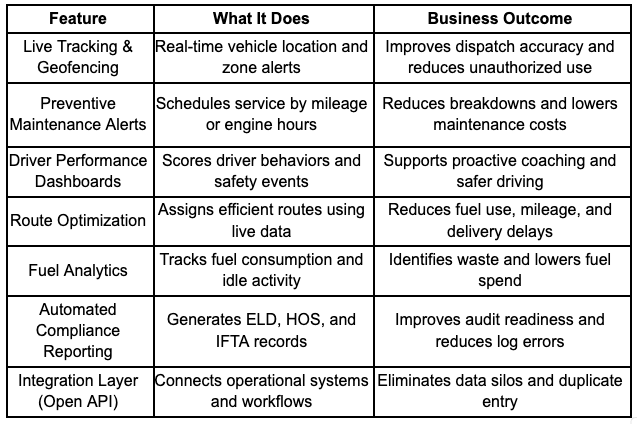
Live tracking and geofencing tools provide real-time vehicle visibility and automatic zone-entry alerts that improve dispatch coordination and reduce unauthorized vehicle use.
Preventive maintenance alerts schedule service intervals based on mileage, engine hours, or diagnostic fault codes, helping fleets reduce unexpected breakdowns and lower long-term maintenance costs (Inbound Logistics).
Driver performance dashboards monitor behaviors such as speeding, harsh braking, rapid acceleration, and excessive idling so fleets can coach drivers proactively before safety incidents occur and help improve fuel utilization.
Route optimization systems analyze traffic conditions, route efficiency, delivery windows, and operational constraints to reduce unnecessary mileage, lower fuel consumption, and improve on-time delivery performance.
Fuel analytics tools track fuel consumption at the vehicle level, helping fleets identify excessive idling, inefficient routing, unusual purchasing patterns, and potential fuel fraud.
Automated compliance reporting workflows generate ELD records, Hours of Service logs, DVIR documentation, and IFTA mileage reports automatically, reducing manual paperwork and improving DOT audit readiness (FMCSA).
Integration layers built on open APIs connect fleet management software with transportation management systems (TMS), ERP platforms, maintenance software, payroll tools, telematics systems, and dispatch workflows to eliminate operational silos.
Fleets exploring connected operational workflows can also review how fleet management tools deliver operational improvements and how maintenance software supports preventive service planning across commercial fleet operations.
What Is the Difference Between Fleet Management Software and Telematics?
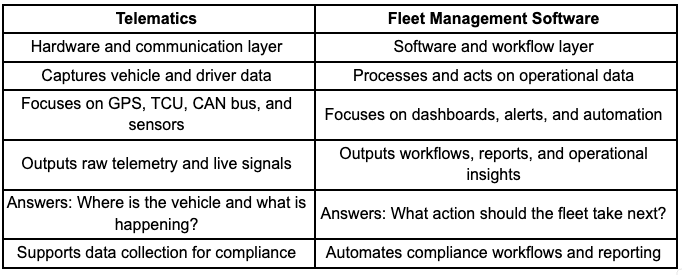
Telematics is the hardware and communications layer that captures and transmits vehicle and driver data such as GPS location, speed, engine diagnostics, and fuel consumption (Inbound Logistics). Fleet management software is the operational platform layer that uses telematics data — along with inputs from ELD systems, mobile apps, and business systems — to automate workflows, generate reports, and support fleet decision-making.
Telematics provides the operational data stream, while fleet management software transforms that information into actionable workflows, alerts, compliance records, and operational insights.
What Is the Difference Between Open and Closed Fleet Management Platforms?
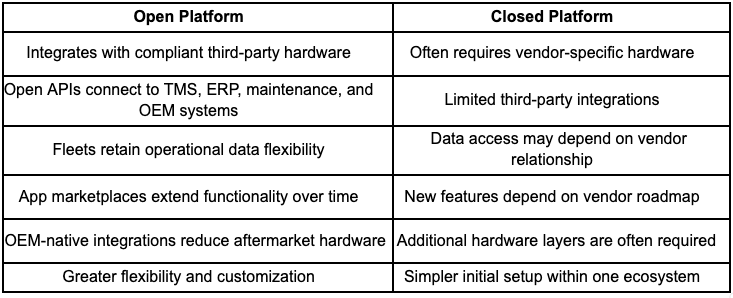
An open fleet management platform allows fleets to integrate third-party apps, telematics hardware from multiple vendors, OEM vehicle data, and existing back-office systems through open APIs and flexible connectivity standards (Wikipedia: Open Platform). A closed platform restricts these integrations, often locking fleets into a single vendor's hardware and software ecosystem and limiting operational flexibility as business needs evolve.
Open fleet management platforms create several operational advantages for commercial fleets.
- Vendor-agnostic hardware support allows fleets to connect compliant telematics devices and onboard systems without replacing existing equipment every time operational requirements change.
- App extensibility enables fleets to add specialized tools for navigation, safety monitoring, dispatch, maintenance, messaging, and workflow automation without switching platforms or rebuilding operational processes.
- Data ownership protections help fleets maintain long-term access to operational data independent of their relationship with a single vendor, reducing the risk of vendor lock-in and disconnected reporting.
- OEM-native integrations connect directly to manufacturer vehicle data streams, eliminating the need for separate aftermarket hardware layers and improving data consistency across connected vehicles.
Closed platforms can still provide advantages in some environments. Because the vendor controls the entire ecosystem, closed systems may offer simpler out-of-box setup experiences and tighter integration across their own hardware and software stack.
Platform Science’s Virtual Vehicle is one example of OEM-native open architecture, connecting directly to embedded vehicle systems while allowing fleets to configure apps and workflows through a broader connected ecosystem.
Fleets evaluating platform flexibility can also explore the Platform Science Marketplace and Virtual Vehicle resources to understand how open app ecosystems support long-term operational scalability.
How Do You Choose Fleet Management Software?
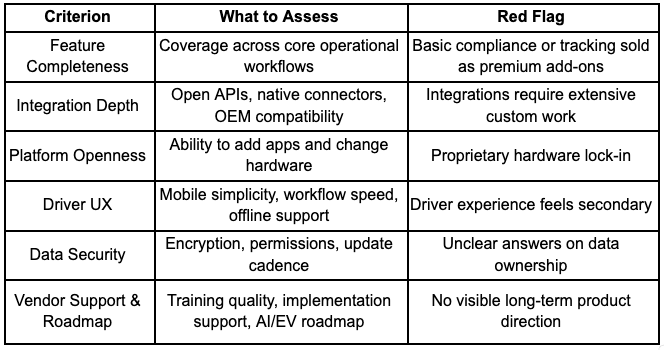
Choosing fleet management software starts with defining operational requirements such as fleet size, vehicle mix, compliance obligations, routing complexity, and existing system integrations. Fleets should then evaluate software providers across six core criteria: feature completeness, integration depth, platform openness, driver usability, data security, and long-term vendor support before piloting the platform on a representative vehicle group.
Most successful fleet software evaluations follow a two-stage process:
- Assess operational needs and define workflow requirements before reviewing vendors.
- Score vendors against standardized evaluation criteria during the selection process.
Feature Completeness
Fleet management software should support core operational workflows without requiring expensive add-ons for basic functionality. Essential capabilities include vehicle tracking, preventive maintenance, compliance reporting, fuel analytics, driver performance management, and route optimization.
Integration Depth
Strong platforms connect directly with TMS platforms, ERP systems, maintenance software, telematics hardware, OEM vehicle data, payroll systems, and dispatch tools through open APIs and native integrations. Long integration lists alone are not enough if every connection requires custom development work.
Platform Openness
Open architecture allows fleets to extend functionality, add apps, connect OEM systems, and evolve operational workflows without replacing hardware or rebuilding the software environment from scratch.
Driver User Experience
Driver adoption depends heavily on usability. Drivers interact with fleet software daily through mobile apps, inspections, navigation tools, messaging systems, and Hours of Service workflows. Complex interfaces create friction, increase errors, and reduce long-term adoption. Redundant tasks and busywork reduce job satisfaction and can lead to increased turnover.
Data Security
Fleet management software handles sensitive operational and driver information and should include encryption, role-based access controls, firmware update policies, and clear breach notification procedures. Fleets should also understand how vendors manage data retention, cybersecurity, and ownership policies before committing to a platform.
Vendor Support and Product Roadmap
Implementation support, onboarding resources, ongoing training, and a credible product roadmap all influence long-term platform success. Fleets evaluating providers should assess whether the vendor is investing in areas such as electrification support, AI-driven workflows, OEM-native integrations, and connected operations.
Before full deployment, fleets should pilot software on a representative subset of vehicles, routes, and drivers to validate integrations, usability, reporting accuracy, and operational workflows under real operating conditions.
Fleets researching software evaluation frameworks can also review buyer-focused resources such as “Secrets of Fleet Management Software Buyers” and operational content focused on driver retention and technology adoption.
How Much Does Fleet Management Software Cost?
Fleet management software is typically priced as a SaaS subscription based on the number of vehicles, users, or connected assets within the fleet. Total cost varies based on feature depth, hardware requirements, integrations, onboarding complexity, and contract structure, with more advanced platforms adding capabilities such as AI analytics, video intelligence, predictive maintenance, and OEM-native integrations.
Five factors influence fleet management software pricing most directly.
Number of Vehicles or Users
Most fleet software vendors price platforms per vehicle, per asset, or per user seat. Larger commercial fleets often negotiate lower per-unit pricing through enterprise volume agreements. Providers that offer usage based billing take it a step further by charging fleets only for the actual number of vehicles and users that actively used the services that month, eliminating costs on idle or backup vehicles.
Fleets should also inquire about fees that might be associated with increasing or decreasing the number of vehicles or users to help future-proof operations.
Feature Tier
Entry-level software tiers generally focus on vehicle tracking, compliance reporting, and basic operational visibility. Advanced tiers add predictive maintenance, AI-powered analytics, route optimization, video telematics, workflow automation, and deeper reporting capabilities.
Hardware Add-Ons
ELD devices, telematics control units, dashcams, environmental sensors, and connected tablets are often priced separately from the software subscription. Hardware complexity increases implementation costs for fleets operating heavy-duty or mixed-asset environments.
Integration and Professional Services
Custom API integrations, workflow configuration, onboarding assistance, and enterprise implementation support may involve one-time professional service fees in addition to recurring software costs. Fleets should also inquire about ongoing training and customer support availability, and any associated fees.
Contract Length
Multi-year software agreements typically reduce monthly per-vehicle pricing compared to shorter-term or month-to-month subscription structures.
Operational ROI often offsets software costs over time. Fleets typically recover investment through three primary levers: lower fuel spend from route optimization and idle reduction, lower maintenance costs through preventive service scheduling, and reduced administrative overhead and violation fees from automated ELD, Hours of Service, and compliance workflows.
What Are the Emerging Trends in Fleet Management Software?
Four major trends are reshaping fleet management software: AI-driven predictive analytics, electric vehicle fleet management, growing cybersecurity requirements, and increased demand for operational data portability. These trends are changing both the capabilities fleets expect from connected platforms and the evaluation criteria buyers use during software selection.
AI and predictive analytics are becoming standard fleet management capabilities rather than premium add-ons. Modern platforms increasingly use machine learning to identify maintenance risks from engine diagnostics, automate driver coaching recommendations, optimize routing dynamically, and improve dispatch efficiency through predictive operational modeling.
Electric vehicle fleet management is also becoming more important as commercial EV adoption expands. The International Energy Agency reported that electric vehicles accounted for approximately 18% of global new car sales in 2023, accelerating demand for software capable of handling charging management, battery monitoring, range-aware routing, and energy consumption analytics.
Cybersecurity is now a core fleet software evaluation criterion because connected fleet platforms continuously process sensitive driver, vehicle, routing, and compliance data. Fleet operators increasingly evaluate vendors based on encryption standards, access controls, incident response policies, and software update practices in addition to operational functionality.
Data portability and ownership have also become larger concerns for commercial fleets. Many operators now require contractual guarantees that operational data remains accessible and exportable if the fleet changes vendors or restructures technology systems, reducing long-term vendor lock-in risk.
How Platform Science Approaches Fleet Management Software
Platform Science is a connected fleet platform built on the open architecture described throughout this guide. The Platform Science fleet management platform combines an open app ecosystem through the Virtual Vehicle Marketplace with OEM-native connectivity through Virtual Vehicle, allowing fleets to extend functionality and access manufacturer vehicle data without relying on disconnected aftermarket hardware layers.
Fleets exploring connected operations can also learn more about Virtual Vehicle and driver retention strategies through Platform Science resources.
Frequently Asked Questions
What Does Fleet Management Software Integrate With?
Fleet management software integrates with ELD and telematics devices for operational data collection, TMS and dispatch systems for workflow coordination, ERP and payroll platforms for financial reporting, maintenance systems for automated work orders, and OEM vehicle data streams for native diagnostics. Integration depth depends heavily on whether the platform supports open APIs or relies on proprietary vendor-specific connectors.
Can Small Fleets Benefit From Fleet Management Software?
Yes. Small fleets benefit from automated FMCSA compliance workflows, preventive maintenance scheduling, real-time vehicle tracking, fuel visibility, and driver safety monitoring without relying on manual spreadsheets or paper logs. SaaS pricing models and plug-and-play telematics hardware also make fleet management software accessible for smaller operations.
What Is the Difference Between Fleet Management Software and Fleet Maintenance Software?
Fleet management software supports broad operational workflows including tracking, routing, driver management, fuel analytics, compliance, and maintenance coordination. Fleet maintenance software focuses specifically on service scheduling, repair history, work orders, parts inventory, and preventive maintenance workflows. Many fleet management platforms include maintenance modules, while standalone maintenance software typically does not include telematics or compliance functionality.
How Long Does It Take to Implement Fleet Management Software?
Fleet management software implementation timelines vary based on fleet size, hardware requirements, workflow complexity, and system integrations. Smaller fleets using plug-and-play telematics or ELD devices can often deploy software within days, while enterprise implementations involving ERP integrations, custom workflows, and large-scale driver onboarding commonly require four to twelve weeks.
How Does Fleet Management Software Help Reduce Operating Costs?
Fleet management software reduces operating costs through three primary mechanisms: route optimization lowers fuel consumption and idle time, preventive maintenance workflows reduce unexpected breakdowns and repair costs, and automated compliance systems reduce fines and administrative overhead tied to ELD and Hours of Service reporting. Many fleets achieve measurable operational ROI within the first year of deployment through these combined efficiencies.


